

Ankle Arthritis: Everything You Need to Know
Unlike arthritis of the hip or knee, ankle arthritis is relatively uncommon, but it can have a profound effect on everyday life. Walking, climbing stairs, standing for long periods and even sleeping can become increasingly painful as the condition progresses.
Interestingly, ankle arthritis differs from arthritis in many other joints because it is often the result of a previous injury rather than simply ageing. An ankle fracture or repeated severe ankle sprains may gradually damage the cartilage, leading to arthritis years later. Inflammatory conditions such as rheumatoid arthritis can also affect the ankle.
The good news is that many people improve with simple treatments such as weight management, supportive footwear, physiotherapy and activity modification. For those with severe arthritis, modern ankle fusion and total ankle replacement surgery can provide excellent pain relief and restore quality of life.
In this guide we'll explain exactly what ankle arthritis is, why it develops, how it is diagnosed and the latest evidence-based treatments available.
Key points
- Many cases of ankle arthritis develop after previous injury rather than simply ageing.
- Weight-bearing X-rays are usually the most important investigation.
- Most patients improve without surgery using physiotherapy, footwear changes, weight management and pain relief.
- When symptoms become severe, ankle fusion and ankle replacement are both excellent surgical options for carefully selected patients.
- The best operation depends on your age, activity level, ankle alignment and personal goals.
What is ankle arthritis?
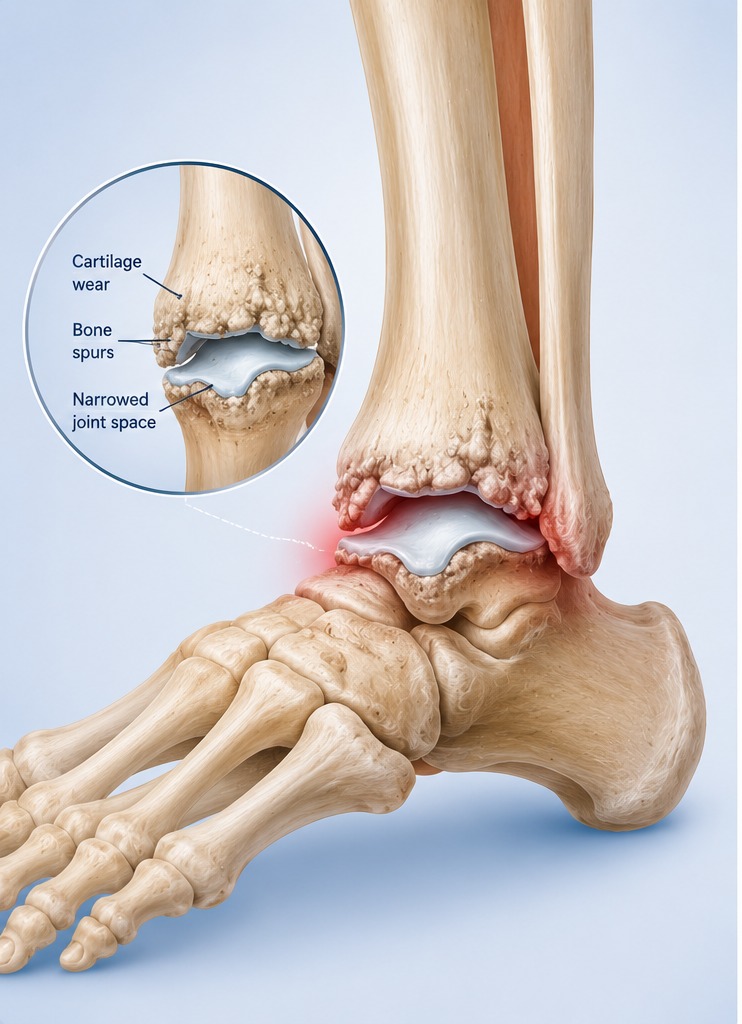
The ankle joint is formed where the shin bone (tibia) meets the talus, creating the main hinge joint responsible for moving your foot up and down. Just beneath this sits the subtalar joint, which allows side-to-side movement and helps you walk on uneven ground.
Healthy joints are covered with a smooth layer of cartilage that allows the bones to glide painlessly. In ankle arthritis this cartilage gradually wears away. As the cartilage becomes thinner the joint space narrows, bone begins rubbing against bone, inflammation develops, small bony spurs (osteophytes) may form, and movement becomes increasingly stiff and painful.
Unlike hip arthritis, where ageing is often the main cause, ankle arthritis is commonly post-traumatic, meaning it develops after an injury. Many cases occur years after an ankle fracture or repeated severe sprains, while inflammatory arthritis and primary osteoarthritis are other recognised causes.
Why does ankle arthritis develop?
Previous ankle injury
This is by far the commonest cause. Examples include a previous ankle fracture, repeated ankle sprains, chronic ankle instability and cartilage injuries. Sometimes arthritis develops 10–20 years after the original injury.
Osteoarthritis
As we age the cartilage gradually becomes less resilient. Although this process affects hips and knees more commonly, it can also occur in the ankle.
Rheumatoid arthritis
Inflammatory arthritis attacks the lining of the joint and over time this damages cartilage and bone. Patients often experience swelling, prolonged morning stiffness and pain affecting multiple joints.
Malalignment
If the ankle is no longer straight following an injury, one side of the joint bears much greater force. This uneven loading accelerates cartilage wear and can speed the progression of arthritis.
Excess body weight
Every additional kilogram of body weight increases the forces passing through the ankle several-fold during walking. Weight reduction is one of the most effective non-operative treatments.
Symptoms
Symptoms usually develop gradually. Pain is normally worse with walking, standing, uneven ground, climbing hills and prolonged activity. As arthritis progresses, pain may also occur at rest, during the night, and after only short walks.
Stiffness
Many people notice difficulty bending the ankle upwards, walking downstairs, squatting and getting out of a chair.
Swelling
Inflammation inside the joint often causes persistent swelling around the ankle.
Reduced walking distance
People often find shopping difficult, holidays less enjoyable and exercise increasingly limited.
Clicking or grinding
Damaged cartilage and bony spurs can produce clicking, cracking and grinding sensations.
Instability
Some patients describe the ankle as “giving way”, particularly if ligament damage is also present.
How is ankle arthritis diagnosed?
Diagnosis starts with a careful history and examination. Your clinician will assess where the pain is, ankle movement, swelling, alignment, your walking pattern and any previous injuries.
Weight-bearing X-rays
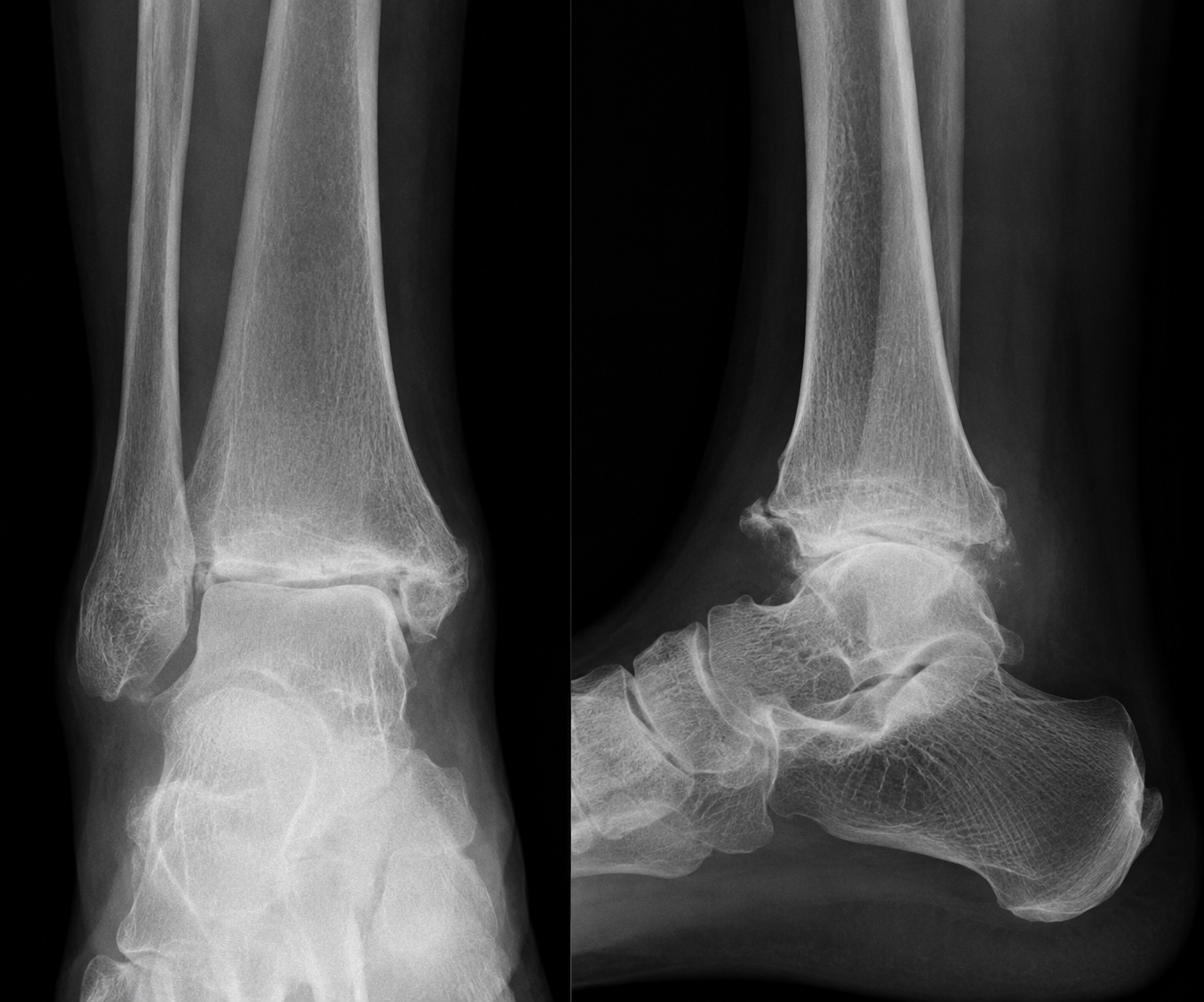
Standing X-rays are usually the most important investigation because they show joint space narrowing, bone spurs, deformity and the overall severity of arthritis.
MRI
MRI is sometimes useful if arthritis is mild, a cartilage injury is suspected, symptoms are unexplained, or surgery is being planned.
CT scan
CT provides excellent detail of bone loss, deformity and previous fractures. It is commonly used when planning reconstructive surgery or fusion.
Treatment for ankle arthritis
The aim of treatment is to reduce pain, improve function and help you stay active for as long as possible. Most people do not need surgery and can manage their symptoms successfully with a combination of lifestyle changes, physiotherapy and simple treatments. Evidence-based guidance recommends exhausting appropriate non-operative measures before considering surgery.
Non-surgical treatment
1. Weight loss
If you are overweight, even modest weight loss can make a significant difference. Every step places several times your body weight through the ankle joint, so reducing weight lowers the forces acting across the damaged cartilage.
2. Activity modification
Remaining active is important, but changing how you exercise often helps. Instead of running, jumping, football or tennis, consider cycling, swimming, rowing, a cross trainer, or walking shorter distances more frequently.
3. Physiotherapy
A physiotherapist can help by improving ankle movement, strengthening supporting muscles, improving balance, reducing stiffness and advising on gait and walking mechanics. Hydrotherapy may also help by allowing exercise with less weight through the joint.
4. Footwear
Good footwear often makes a surprisingly large difference. Helpful features include a stiff sole, a rocker-bottom sole, a cushioned heel, supportive walking boots and good ankle support.
5. Ankle braces
Braces help reduce painful movement. Options include elastic supports, lace-up braces and custom plastic ankle-foot orthoses (AFOs). These can improve confidence and walking distance.

6. Pain relief
Your healthcare professional may recommend paracetamol, anti-inflammatory medication (NSAIDs) or topical anti-inflammatory gels if appropriate for your medical history.
7. Steroid injections
Corticosteroid injections can reduce inflammation and pain. They are often effective, usually begin working within a few days, and relief may last several weeks or several months. However, they do not cure arthritis and repeated injections are generally avoided.
When should surgery be considered?
Surgery is generally considered when pain significantly affects quality of life, walking becomes severely limited, sleep is disturbed, non-surgical treatment has failed, and X-rays show advanced arthritis.
The decision depends not only on X-rays but also on your symptoms, daily activities, work, expectations and response to conservative treatment.
Surgical options
Arthroscopic (keyhole) surgery
In early arthritis, keyhole surgery may help remove loose cartilage, inflamed tissue and bone spurs. It may improve symptoms in selected patients but is generally not effective for advanced “bone-on-bone” arthritis.
Ankle fusion (arthrodesis)
Ankle fusion has been the gold-standard operation for severe ankle arthritis for many years. During surgery the damaged cartilage is removed, the tibia and talus are positioned correctly, and screws (and sometimes plates) hold the bones together until they heal into one solid bone.
Although the ankle no longer moves, many of the surrounding joints continue to move, allowing surprisingly good overall function. Advantages include excellent pain relief, durability, suitability for younger active patients and no implant wear. Disadvantages include loss of ankle movement, greater stress on nearby joints over time and a lengthy recovery.
Studies suggest that fusion is successful in 90-95% of cases with marked pain relief.
Total ankle replacement
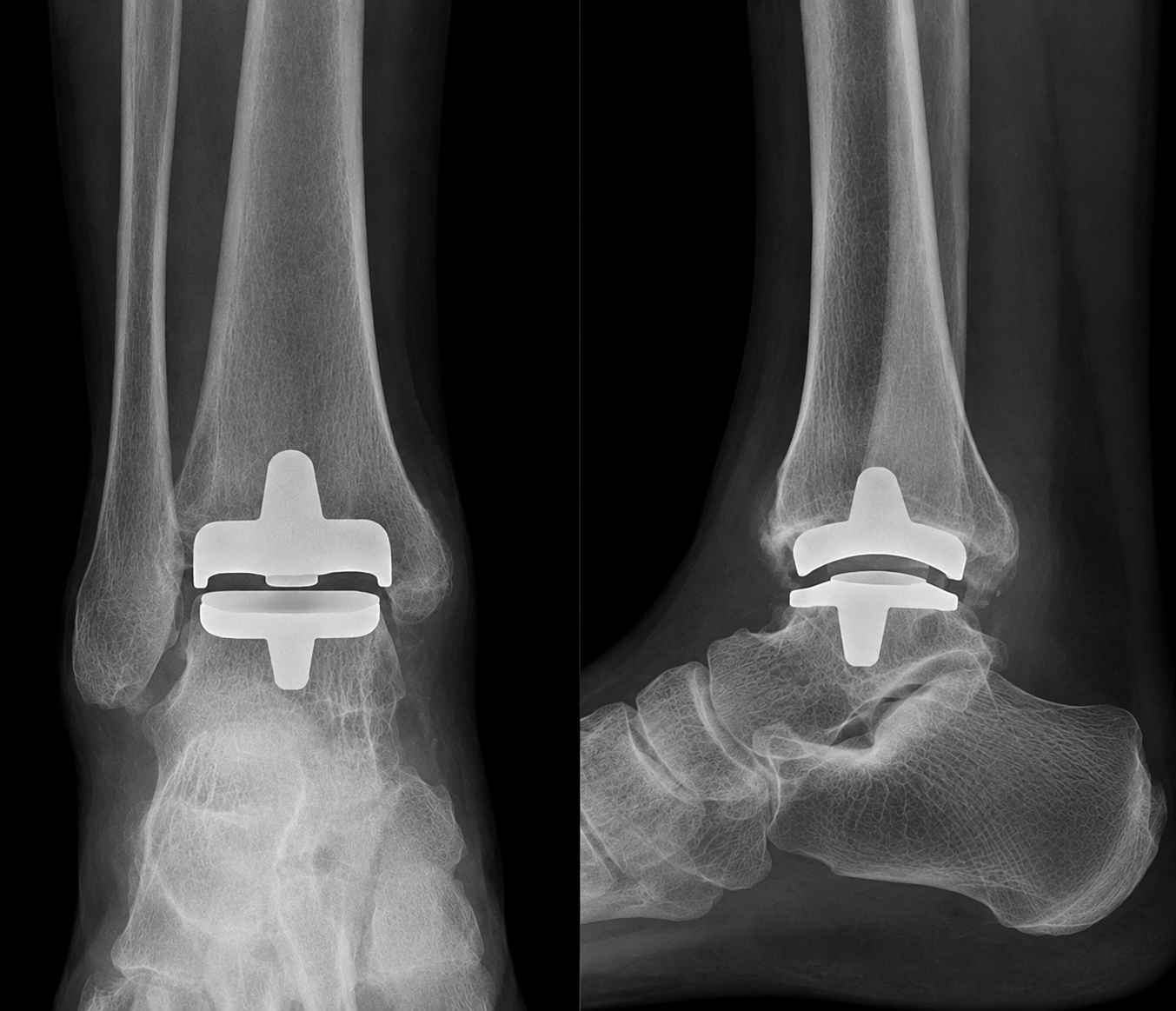
A total ankle replacement removes the damaged joint surfaces and replaces them with metal components separated by a plastic bearing. Unlike fusion, this aims to preserve movement while relieving pain.
Advantages include pain relief, maintained ankle motion, a more natural walking pattern and reduced stress on nearby joints. Disadvantages are that implants eventually wear out, especially in younger and more active patients, and for this reason ankle replacement is generally not advised for this group. Revision surgery may be required, and long-term results are not yet as predictable as for hip or knee replacement.
More than 90% of patients report good short-term satisfaction, and approximately 80–90% of ankle replacements remain functioning at ten years.
Fusion or replacement — which is better?
There is no single “best” operation. Instead, the choice depends on several factors.
| Ankle fusion | Total ankle replacement |
|---|---|
| Younger patients | Older, lower-demand patients |
| Heavy manual work | Lower activity levels |
| Severe deformity | Good alignment |
| Excellent long-term durability | Preserves movement |
| No implant wear | Risk of future revision |
Recovery after surgery
Recovery takes time whichever procedure is performed. Typical milestones include:
| Time | What to expect |
|---|---|
| 0–2 weeks | Elevation, wound healing, pain control |
| 2–6 weeks | Cast or boot, limited weight-bearing depending on procedure |
| 6–12 weeks | Gradual increase in walking |
| 3–6 months | Improving mobility and confidence |
| 6–12 months | Ongoing improvement, swelling gradually settles |
Prognosis
Most patients achieve good long-term pain relief. Many return to walking, cycling, golf, travel, gardening and everyday activities.
However, high-impact sports such as running, squash and football are generally discouraged after either fusion or replacement because of the increased stresses placed on the ankle and surrounding joints.
When should you seek medical advice?
Arrange assessment if you have ankle pain lasting more than six weeks, increasing swelling, stiffness affecting daily life, pain after a previous ankle injury, difficulty walking, pain that disturbs sleep, or progressive ankle deformity.
Seek urgent medical attention if you develop an inability to bear weight after injury, rapidly increasing swelling, redness with fever, severe calf pain or swelling, or numbness or changes in foot colour.
Top tips
- Keep moving — low-impact exercise such as cycling or swimming helps maintain joint mobility and muscle strength.
- Wear supportive footwear: a stiff-soled or rocker-bottom shoe reduces painful ankle motion during walking.
- Maintain a healthy weight — even modest weight loss reduces the load passing through the ankle with every step.
- Don't ignore persistent pain: early assessment can identify whether braces, injections or physiotherapy might help.
- Discuss all your options — if surgery becomes necessary, ask why fusion or replacement suits your lifestyle and goals.
Related articles

Ankle Sprains: Symptoms, Treatment and Recovery
A complete patient guide to ankle sprains: which ligaments are injured, grading, the first 72 hours, rehabilitation, return to sport and when to seek help.

Achilles Tendinopathy: Symptoms, Causes, Treatment and Recovery
Learn about Achilles tendinopathy, including symptoms, diagnosis, evidence-based treatment, exercises, recovery and when surgery may be needed.

Plantar Fasciitis (Plantar Fasciopathy): Symptoms, Treatment and Recovery
An evidence-based guide to plantar fasciitis: symptoms, causes, treatments, exercises, recovery and when to seek medical advice.