
Trigger Finger (Stenosing Tenosynovitis): Symptoms, Causes, Treatment and Recovery
If one of your fingers suddenly clicks, catches or locks when you bend or straighten it, you may have trigger finger, also known as stenosing tenosynovitis.
Trigger finger is a common condition affecting the tendons that bend the fingers and thumb. It occurs when the tendon can no longer glide smoothly through its protective tunnel (sheath), causing it to catch as the finger moves. In the early stages you may simply notice an occasional click, but over time the finger may become stuck in a bent position and require your other hand to straighten it.
Although trigger finger can be painful and frustrating, it is not dangerous, and many mild cases improve without surgery. Treatment ranges from simple activity modification and splinting to steroid injections and, if necessary, a small operation with excellent success rates.
Key points
- Trigger finger occurs when the flexor tendon catches within its tendon sheath, causing clicking or locking.
- The thumb and ring finger are the most commonly affected digits.
- Many mild cases improve with rest, splinting and activity modification.
- Steroid injections relieve symptoms in around 70–80% of patients, although success is lower in people with diabetes.
- Trigger finger release surgery is highly successful when conservative treatment has failed, and recurrence afterwards is uncommon.
What is trigger finger?
Trigger finger is a condition in which a finger or thumb clicks, catches or locks during movement. Doctors also call it stenosing tenosynovitis.
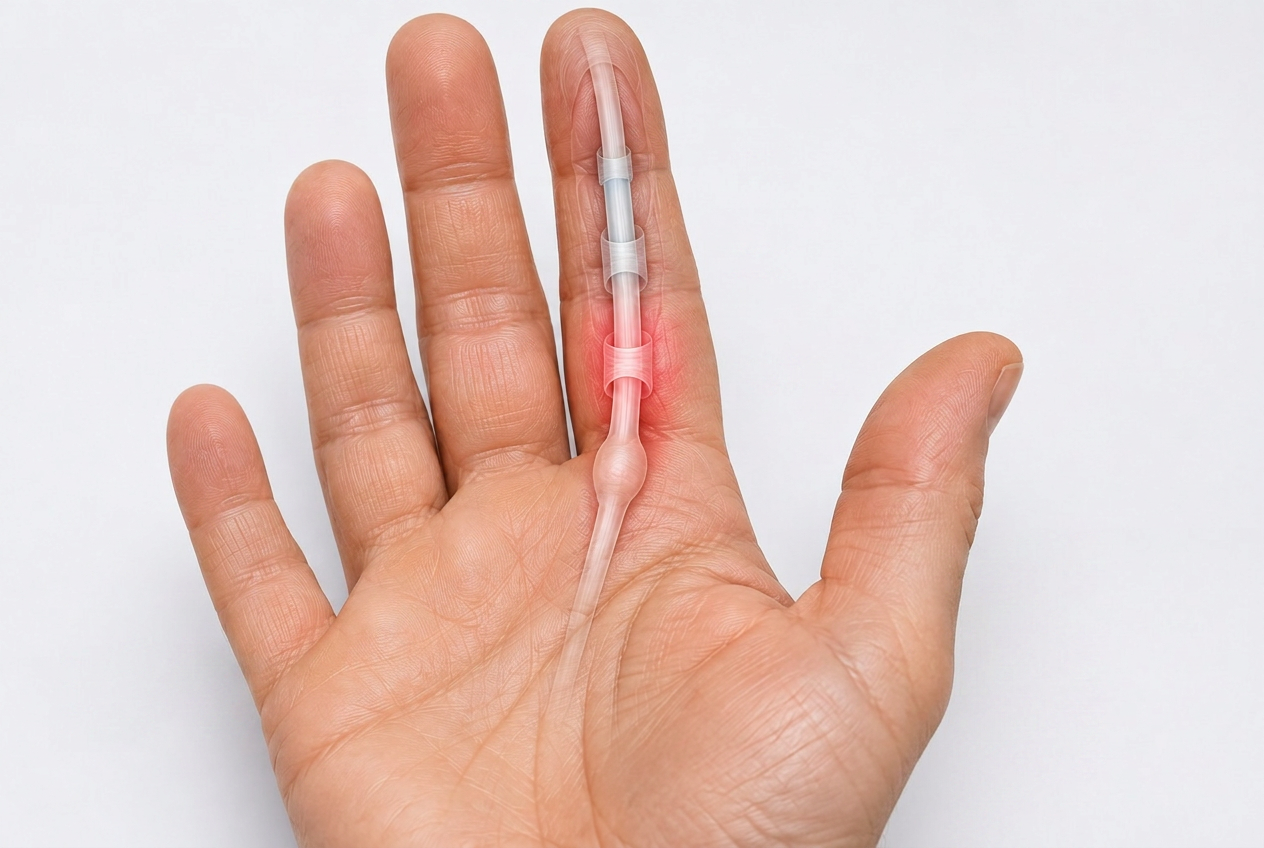
Normally, the tendon that bends your finger slides smoothly through a series of fibrous tunnels called pulleys. In trigger finger this smooth movement becomes disrupted: the tendon catches as it passes through the opening of the tendon sheath, producing clicking, catching, locking, pain and stiffness.
As the condition progresses, the finger may remain bent until it is manually straightened using the opposite hand.
Understanding finger anatomy
To understand trigger finger, it helps to understand how the finger normally bends. Each finger contains two flexor tendons (one in the thumb), a tendon sheath, a series of pulleys, the finger joints, and nearby nerves and blood vessels.
The flexor tendons connect muscles in the forearm to the bones of the fingers. When these muscles contract, the tendons slide through the tendon sheath and bend the finger. The pulleys act like small loops that keep the tendons close to the bone, allowing efficient finger movement. Under normal circumstances the tendon glides effortlessly through these pulleys.
Why does the finger lock?
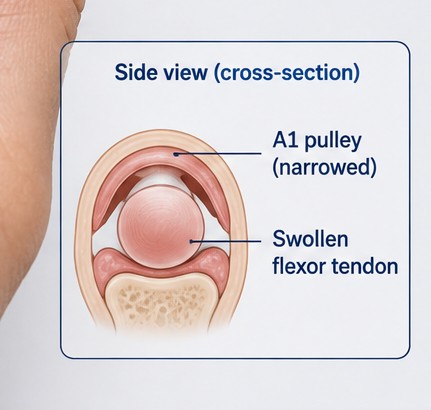
The problem usually occurs at the A1 pulley, located near the base of the finger in the palm. The opening of the tendon tunnel becomes thickened, making it difficult for the tendon to pass through smoothly. The tendon may also develop a small nodule or become swollen, increasing the likelihood of it catching within the narrowed pulley.
As you bend the finger, the swollen tendon passes through the tight pulley, catches within the narrowed opening, then suddenly releases with a click — and in more severe cases becomes stuck altogether. This explains why patients often describe the sensation as though the finger is "getting stuck" before suddenly snapping straight.
Which fingers are most commonly affected?
Trigger finger can affect any finger, the thumb (trigger thumb), or more than one digit at the same time. The ring finger and thumb are affected most commonly. The condition may affect your dominant hand, your non-dominant hand, or both hands.
What causes trigger finger?
In many people there is no obvious cause, and most cases occur in otherwise healthy individuals without any specific injury.
The most common mechanism is thickening of the entrance to the tendon sheath: as this becomes narrower, the tendon can no longer glide freely. Inflammation around the tendon or sheath may contribute to swelling and make the tendon more likely to catch.
Repetitive gripping and forceful hand activities — gardening, using secateurs, prolonged gripping, heavy manual work and repetitive tool use — can aggravate symptoms, although they are not thought to be the sole cause.
Who is most at risk?
Trigger finger is most common in adults over the age of 40, and women are affected more commonly than men. People with diabetes are significantly more likely to develop it, and steroid injections are less successful in people with insulin-dependent diabetes. Trigger finger may also occur in people with rheumatoid arthritis because tendon nodules can develop along the flexor tendons. Occasionally symptoms appear after a knock or injury to the hand, although this is much less common than spontaneous onset.
Symptoms
Symptoms often begin gradually and may worsen over several weeks or months. Common symptoms include pain at the base of the finger or thumb, tenderness in the palm, clicking during movement, catching while straightening the finger, stiffness (particularly first thing in the morning), locking of the finger in a bent position, needing the opposite hand to straighten the finger, and a small lump or nodule at the base of the finger.
Many patients notice that symptoms are worst on waking and improve slightly as the hand warms up during the day.
Trigger finger versus trigger thumb
Although the underlying condition is the same, trigger thumb often presents slightly differently. People with trigger thumb commonly notice pain at the base of the thumb, reduced movement at the thumb tip, locking during thumb movement and difficulty gripping or pinching objects. Stiffness at the end joint of the thumb is particularly common.
How is trigger finger diagnosed?
Trigger finger is usually diagnosed during a consultation, based on your symptoms, medical history and examination of the hand. Your clinician will assess where the pain is located, whether clicking or locking is present, tenderness over the A1 pulley, whether a tendon nodule can be felt, how easily the finger moves and whether more than one digit is affected.
In most cases blood tests are not required, X-rays are unnecessary and MRI scans are not needed. The diagnosis is almost always made clinically.
Observation and activity modification
If symptoms are mild, no immediate treatment may be required — around 1 in 5 people improve without any specific treatment as the inflammation settles naturally. Observation is particularly appropriate if the finger only clicks occasionally, locking is infrequent, pain is mild, symptoms have only recently started and hand function remains good.
Reducing activities that repeatedly force the tendon through the tight pulley can help: prolonged gripping, secateurs, heavy gardening, repetitive use of scissors, vibrating tools and repeated squeezing. Rather than stopping these activities altogether, it is often enough to take regular breaks, alternate tasks and reduce forceful gripping while symptoms are active.
Ice massage, medication and warm water
If the base of the finger is painful or inflamed, ice massage may help: apply a small amount of oil to the skin, wrap an ice cube in cloth or cling film, and firmly rub the ice over the painful area until the ice has melted.
Simple pain relief such as ibuprofen gel, oral anti-inflammatory medication (if appropriate for you) or paracetamol may reduce discomfort while the tendon settles, although medication does not correct the underlying mechanical problem.
Many people find that soaking the hand in warm water first thing in the morning helps loosen the tendon before attempting to straighten the finger.
Splinting
One of the most effective early treatments is wearing a trigger finger splint. The splint keeps the finger straight, particularly overnight, preventing the swollen tendon repeatedly catching within the tight pulley while you sleep. The aim is to rest the tendon, reduce inflammation, allow the thickened pulley to settle and reduce morning locking.
A short splint that limits movement only at the base of the affected finger is preferred, rather than immobilising the whole hand. Night splinting is particularly effective for mild triggering and for symptoms that are worse first thing in the morning, and some people notice improvement after several weeks of consistent use.
Hand therapy and tendon gliding exercises
Hand therapists play an important role in managing trigger finger through education, splint fitting, activity advice, exercises, swelling management and guidance on returning to work or sport. The aim is not simply to reduce pain, but to encourage smoother tendon movement while minimising further irritation.
Modified tendon-gliding exercises encourage the tendons to move more freely within the sheath. Typical exercises include making a gentle fist and then fully straightening the fingers, bending only at the large knuckle while keeping the finger joints straight, and using the opposite hand to gently help the fingers into a fist before slowly straightening them again. These are usually performed 5–10 repetitions, around four times each day. Exercises should be comfortable and should not force a locked finger straight.
Steroid injections
If symptoms persist despite splinting and activity modification, a corticosteroid injection is often the next step. The steroid is injected around the tendon sheath near the A1 pulley, reducing inflammation and swelling so the tendon can glide more freely. A local anaesthetic is often mixed with the steroid to make the injection more comfortable.
Injections relieve symptoms in around 7 to 8 out of 10 patients, with less predictable results in people with diabetes. Improvement may occur within a few days or over several weeks. If symptoms return or fail to improve, a second injection may be considered after approximately three months.
Steroid injections are generally very safe. Possible side effects include temporary soreness after the injection and, very occasionally, thinning or lightening of the skin at the injection site. People with diabetes should be aware that steroid injections may temporarily raise blood sugar levels.
When should you see a hand surgeon?
You should seek specialist assessment if the finger becomes permanently locked, you regularly need the other hand to straighten it, symptoms persist despite splinting, steroid injections have failed, pain significantly affects work or daily activities, more than one finger is affected, or you are unsure of the diagnosis. Persistent locking despite conservative treatment is an indication to consider surgical release of the tendon sheath.
What happens if trigger finger is left untreated?
Many mild cases settle naturally. However, more severe trigger finger may gradually progress: clicking may become more frequent, locking may last longer, stiffness may increase, finger movement may reduce, and a permanent flexion contracture can occasionally develop if the finger remains bent for prolonged periods. For this reason, persistent or worsening symptoms should be assessed rather than simply tolerated.
Percutaneous (needle) release
One surgical option is a percutaneous trigger finger release, a minimally invasive procedure performed under local anaesthetic. A fine needle is inserted through the skin and used to divide the tight A1 pulley without making a formal incision. Once the pulley is released, the tendon can move freely again.
Advantages include a tiny skin puncture, no stitches, a short procedure, rapid recovery and minimal postoperative discomfort. However, percutaneous release is not suitable for every finger and may not be appropriate where important nerves lie close to the pulley, particularly in the thumb.
Open trigger finger release
The commonest surgical procedure is an open trigger finger release, one of the most frequently performed hand operations. A small incision (usually 1–2 cm) is made in the palm, the A1 pulley is identified and divided, the tendon is checked to ensure it glides freely, and the skin is closed with stitches. The operation usually takes 10–20 minutes and is commonly performed under local anaesthetic as a day case.
Importantly, the tendon itself is not removed or cut — the operation simply enlarges the space available for the tendon to move.
More than 95% of patients experience complete resolution of triggering after surgery, and recurrence is uncommon. Most notice immediate disappearance of the locking, smoother finger movement, gradual reduction in pain and improved hand function over the following weeks. If the finger has been locked for a long time before surgery, full movement may take longer to recover because the joints themselves may have become stiff.
Recovery after surgery
Recovery is usually straightforward, and patients are encouraged to begin moving the finger immediately after surgery to prevent stiffness.
| Time | Recovery |
|---|---|
| First few days | Finger movement encouraged, light dressings, hand elevation to reduce swelling |
| 10–14 days | Stitches removed (if non-dissolvable), wound healing progressing |
| 2–4 weeks | Light activities and office work usually comfortable |
| 4–6 weeks | Most everyday activities resumed |
| 6–12 weeks | Grip strength and comfort continue to improve, scar softens |
Not everyone requires formal hand therapy. However, if stiffness develops, a hand therapist may recommend finger range-of-motion exercises, tendon gliding exercises, scar massage, swelling management and strengthening exercises. Early movement is encouraged because keeping the finger still for prolonged periods can lead to stiffness.
Possible risks
Trigger finger release is a very safe procedure, but no operation is completely without risk. Possible complications include infection, bleeding, delayed wound healing, scar tenderness, temporary stiffness, incomplete release requiring further surgery, recurrence (uncommon), injury to nearby nerves or blood vessels (rare) and complex regional pain syndrome (very rare). Fortunately, serious complications are uncommon.
Treatment comparison
| Treatment | Best for | Advantages | Limitations |
|---|---|---|---|
| Observation | Mild, early symptoms | No intervention required | Symptoms may persist or progress |
| Activity modification | Symptoms related to repetitive gripping | Simple, no cost | May not resolve established triggering |
| Splinting | Mild to moderate triggering | Non-invasive, particularly effective for night symptoms | Requires consistent use over several weeks |
| Steroid injection | Persistent symptoms without fixed locking | High success rate, avoids surgery for many patients | Less effective in diabetes, symptoms may recur |
| Percutaneous release | Selected patients with suitable anatomy | Tiny puncture, rapid recovery | Not suitable for every finger, operator dependent |
| Open trigger finger release | Persistent or locked trigger finger | Very high success rate, durable results | Minor operation with a short recovery period |
Frequently asked questions
Will trigger finger go away by itself? Sometimes — around 20% of cases improve without specific treatment, particularly when symptoms are mild and of short duration.
Is it caused by arthritis? No. Although arthritis and trigger finger can occur together, trigger finger is a problem with the tendon and its pulley, not the joint itself.
Can I still use my hand? Yes. Gentle use is encouraged, although reducing activities that repeatedly aggravate symptoms may help the tendon recover.
Can trigger finger come back? Recurrence after surgery is uncommon, although it can occur. Some people later develop trigger finger in a different finger, particularly if they have diabetes or inflammatory arthritis.
The OrthoZone take-home message
Trigger finger is a common condition in which the flexor tendon catches as it passes through a narrowed pulley at the base of the finger. This causes clicking, locking and pain, particularly in the morning. Many mild cases improve with splinting, activity modification or steroid injections, while persistent or severe cases can be successfully treated with a small surgical procedure. With appropriate treatment the outlook is excellent, and most people regain normal finger function and return to their usual activities.
Top tips
- Early treatment often prevents worsening — mild symptoms may settle with splinting and activity modification.
- Night splints work best when used consistently, every night for several weeks.
- Steroid injections are highly effective, although success is lower in people with diabetes.
- Surgery is small but very successful, reliably restoring smooth tendon movement in the vast majority of patients.
- Move the finger after surgery — early movement helps prevent stiffness and promotes the best recovery.
Related articles
Carpal Tunnel Syndrome: Symptoms, Diagnosis and Treatment
An evidence-based guide to carpal tunnel syndrome: why the median nerve becomes compressed, night-time symptoms, splints, injections, surgery and recovery.
Dupuytren's Disease (Dupuytren's Contracture): Symptoms, Causes, Treatment and Recovery
An evidence-based guide to Dupuytren's disease: palm nodules, finger contracture, the tabletop test, needle fasciotomy, fasciectomy, recovery and recurrence.