Dupuytren's Disease (Dupuytren's Contracture): Symptoms, Causes, Treatment and Recovery
Finding a lump in the palm of your hand or noticing that one of your fingers is slowly curling towards the palm can be worrying. Fortunately, this is often caused by Dupuytren's disease, a common condition affecting the connective tissue beneath the skin of the hand.
Unlike arthritis, Dupuytren's disease does not affect the joints themselves. Instead, the tissue within the palm gradually thickens and tightens over months or years. In some people it remains mild for life, while in others it can eventually make it difficult to straighten one or more fingers.
The good news is that many people never need treatment. When the condition begins to interfere with everyday activities, however, several effective treatment options are available, ranging from minimally invasive needle procedures to more extensive surgery.
Key points
- Dupuytren's disease affects the fascia beneath the skin of the palm — not the tendons or joints.
- Many people never require treatment.
- Treatment is usually recommended only when finger contractures begin to affect hand function.
- Several effective procedures are available, each with different recovery times and recurrence rates.
- Treatment improves finger straightening but does not cure the disease, so recurrence remains possible.
What is Dupuytren's disease?
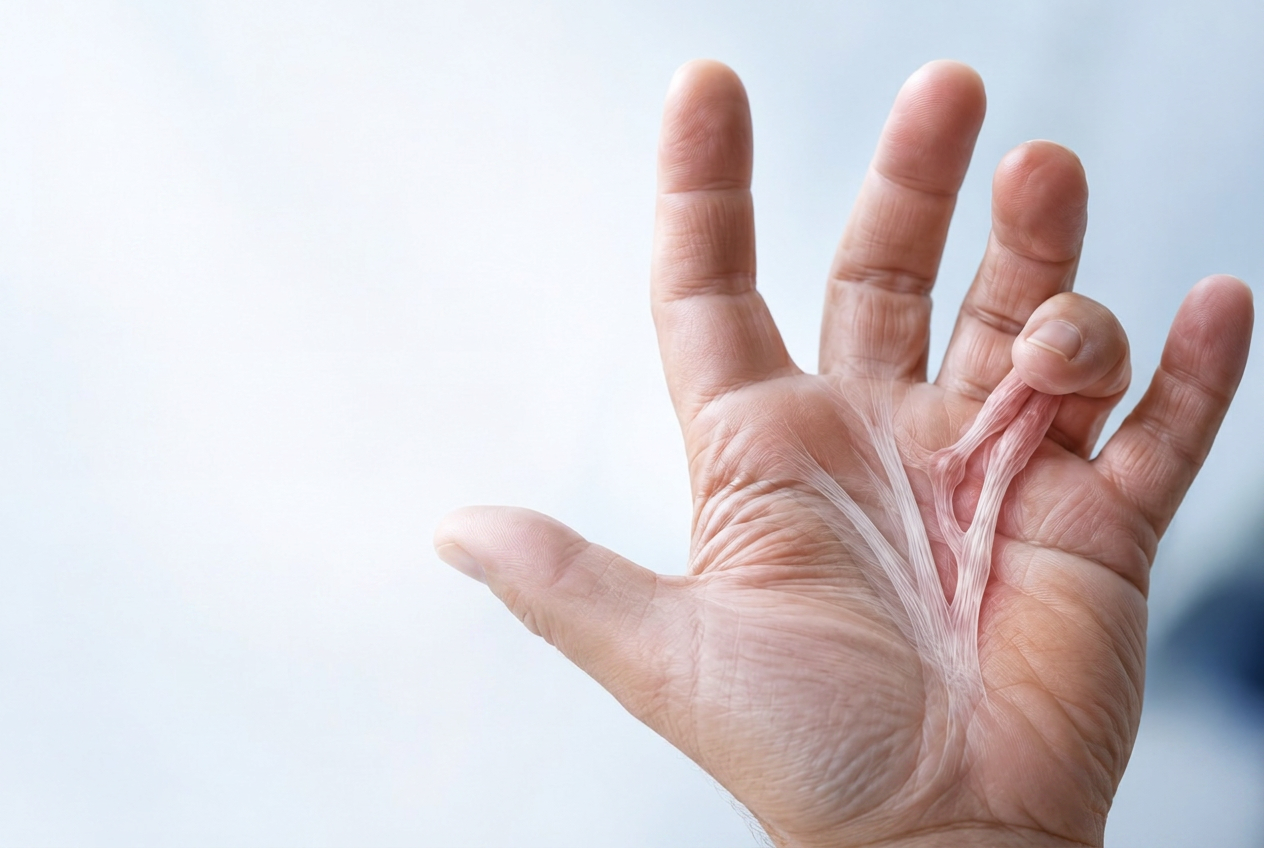
Dupuytren's disease is a condition in which the palmar fascia — a layer of connective tissue lying just beneath the skin of the palm — becomes abnormally thickened.
Over time this tissue may develop into small firm nodules, thick fibrous cords, tightening of the fascia and progressive bending (contracture) of one or more fingers.
Although many people use the terms Dupuytren's disease and Dupuytren's contracture interchangeably, they are not quite the same. Dupuytren's disease describes the underlying condition. Dupuytren's contracture refers to the stage where the thickened tissue has become tight enough to bend one or more fingers towards the palm.
What happens inside the hand?
Many people understandably assume the tendons are becoming tight. In fact, the finger tendons are usually completely normal. Instead the fascia beneath the skin thickens, collagen is laid down in an abnormal pattern, nodules form, these develop into fibrous cords, the cords gradually shorten and the fingers are pulled into flexion.
Because the problem lies within the fascia, stretching the fingers cannot reverse the disease.
Which fingers are affected?
Dupuytren's disease most commonly affects the ring finger, followed by the little finger and then the middle finger. The index finger and thumb are less commonly involved, although thumb web-space contractures can occasionally occur and may significantly affect hand function.
The condition often affects both hands, although one hand may be worse than the other.
What are the symptoms?
Symptoms usually develop very slowly over many months or years.
Early symptoms include a painless lump in the palm, thickening beneath the skin, pits or dimples in the skin, tightening of the palm and occasionally discomfort when gripping objects.
As the disease progresses, thick cords become visible, fingers gradually bend, straightening becomes difficult, gripping large objects becomes harder and placing the hand flat on a table becomes impossible.
Unlike arthritis, pain is usually not the main problem. Most people notice loss of movement long before pain becomes significant.
The tabletop test
One of the simplest ways to assess Dupuytren's disease is the tabletop test. Try placing your hand flat on a table. If the palm lifts off the surface, one or more fingers cannot fully straighten, or the hand cannot lie flat, this suggests a contracture may have developed. The inability to place the hand flat on a table is one of the commonest reasons for referral to a hand surgeon.
How quickly does it progress?
One of the commonest questions patients ask is: "Will it definitely get worse?" The answer is not necessarily. Dupuytren's disease behaves very differently from person to person. Some people have one small lump that never changes, mild thickening for decades, or slow progression over many years. Others develop multiple cords, rapidly increasing contractures and significant loss of finger movement.
Patient information from the NHS decision aid suggests that over seven years approximately 7 in 100 people improve without treatment, 71 remain stable and 22 experience worsening. This is why many patients are simply monitored rather than treated immediately.
What causes Dupuytren's disease?
Despite extensive research, the exact cause remains unknown. It appears to result from abnormal activity of cells within the fascia that produce excessive collagen, causing thickening and shortening of the connective tissue.
Importantly, it is not caused by overusing your hands, it is not an infection, it is not a cancer and it is not arthritis. Although the disease resembles scar tissue under the microscope, it usually develops without any significant injury.
Who is more likely to develop it?
Several risk factors have been identified. The condition becomes much more common with increasing age. Men are affected considerably more often than women, and disease in men tends to progress more quickly. Dupuytren's commonly runs in families, suggesting a strong genetic component, and is particularly common in people of Northern European descent — sometimes nicknamed the "Viking disease", although this is an oversimplification. Diabetes, smoking and heavy alcohol consumption are all associated with increased risk. The evidence around heavy manual work and vibration exposure is less clear.
| Age | Approximate prevalence |
|---|---|
| 55 years | 12% |
| 65 years | 21% |
| 75 years | 29% |
How is Dupuytren's disease diagnosed?
One of the reassuring aspects of Dupuytren's disease is that it is usually diagnosed through a careful clinical examination. In most cases no blood tests are required, no X-rays are needed, MRI scans are rarely necessary and ultrasound is seldom helpful.
Instead, your clinician will examine your hand and assess the presence of nodules, thickened cords, which fingers are affected, how much the fingers can straighten and whether the condition interferes with everyday activities. The BSSH/GIRFT pathway also recommends asking about hand dominance, occupation, hobbies, previous hand surgery, previous recurrence, diabetes, smoking, family history and impact on daily function.
Other conditions that can look similar
Several other conditions can occasionally resemble Dupuytren's disease, including ganglion cysts, trigger finger, giant cell tumours, calluses, diabetic cheiroarthropathy, joint contractures, previous hand injuries and nerve problems. An experienced hand specialist can usually distinguish these during examination.
Can Dupuytren's affect other parts of the body?
Yes. Although the palm is the commonest site, similar changes in connective tissue can occasionally occur elsewhere. These include Ledderhose disease (fibrous nodules affecting the sole of the foot), Peyronie's disease (scar tissue within the penis causing curvature during erection) and Garrod's pads, or knuckle pads (firm nodules over the back of the finger joints). Not everyone with Dupuytren's develops these conditions, but they occur more commonly than in the general population.
When is treatment needed?
One of the biggest misconceptions is that every lump should be removed. In reality, most people do not need treatment when the disease first develops. Treatment is usually recommended only when the disease begins to interfere with hand function, rather than simply because nodules are present.
Observation is often the best approach for early disease. You may not need treatment if the fingers remain straight, you can place your hand flat on a table, hand function is normal, there is little discomfort and the disease has remained stable. Importantly, delaying treatment for a mild, stable nodule does not mean you have missed your opportunity for successful treatment.
When should you see a hand surgeon?
Referral is usually appropriate if you can no longer place your hand flat on a table (positive tabletop test), the finger is beginning to interfere with work or daily activities, the contracture is progressing, thumb movement is becoming restricted, there is diagnostic uncertainty, or painful nodules persist despite conservative treatment.
The BSSH/GIRFT pathway recommends referral when there is approximately 30° or more of contracture at the metacarpophalangeal (MCP) joint, approximately 20° or more at the proximal interphalangeal (PIP) joint, thumb contracture affecting function, rapidly progressive disease, or persistent painful nodules requiring specialist assessment.
Can physiotherapy cure Dupuytren's?
Unfortunately, no. Unlike muscle tightness, Dupuytren's disease results from abnormal thickening of the fascia, and exercises cannot stretch away the diseased tissue. Current evidence suggests that stretching does not stop progression, splints do not prevent worsening and routine physiotherapy does not alter the natural history of the disease.
However, physiotherapy plays an important role after surgery, helping patients regain movement, reduce stiffness and manage scar tissue.
Steroid injections
Some patients develop painful nodules before any finger contracture develops. In these cases, corticosteroid injections may sometimes help reduce pain and soften the nodules.
It is important to understand their limitations: they do not straighten bent fingers, they do not cure the disease and their effect may be temporary. The NHS decision aid notes that injections may soften painful nodules in many patients, but around half experience recurrence within one to three years. Steroid injections are therefore generally reserved for selected patients with painful early disease rather than established contractures.
Radiotherapy and collagenase
Radiotherapy has attracted increasing interest as a treatment for very early Dupuytren's disease. It involves delivering several low doses of radiation to the affected area, aiming to slow progression before significant contracture develops. Current evidence suggests it may reduce progression in selected patients, but the evidence remains limited, so NICE advises it should generally be offered only within research studies or after careful discussion of the benefits and risks. Possible side effects include dry skin, skin irritation, skin thinning and a very small theoretical long-term risk of cancer.
Collagenase injections work by dissolving the collagen within the Dupuytren's cord, allowing the finger to be manipulated straight afterwards. Although previously available in the UK, collagenase is not currently available on the NHS and its availability in the private sector is also limited.
Why is earlier treatment sometimes better?
Many patients assume it is best to wait until the finger becomes very bent before considering treatment. However, long-standing contractures can become more difficult to correct, associated with joint stiffness and associated with permanent shortening of surrounding tissues. In particular, contractures affecting the PIP joint (the middle finger joint) become increasingly difficult to fully correct as time passes. For this reason, many hand surgeons recommend treatment before severe deformity develops, particularly when function is beginning to decline.
Needle fasciotomy
One of the least invasive treatments is needle fasciotomy, sometimes called percutaneous needle fasciotomy (PNF) or needle aponeurotomy. Rather than removing the diseased tissue, the surgeon uses a fine needle to divide the Dupuytren's cord at several points beneath the skin. Once weakened, the cord can often be gently broken, allowing the finger to straighten. The procedure is usually performed under local anaesthetic, as an outpatient, without stitches and through tiny puncture wounds.
Advantages include very small skin punctures, no large incision, a quick procedure, rapid recovery, minimal postoperative discomfort and early return to everyday activities — many patients resume light use of the hand within a few days.
The main disadvantage is that needle fasciotomy does not remove the diseased fascia; it simply divides the tight cord. As a result recurrence is more common, repeat treatment may be required, severe contractures may not fully correct and it is less suitable for complex disease. It is generally best suited to isolated cords, older patients and those wanting the shortest recovery.
Limited fasciectomy
The most commonly performed operation for Dupuytren's disease is a limited fasciectomy. Unlike needle fasciotomy, this operation removes the diseased fascia rather than simply dividing it. During surgery an incision is made in the palm, the skin is carefully lifted, the diseased cords are identified, the abnormal fascia is removed, nearby nerves and blood vessels are protected and the wound is closed with stitches.
Compared with needle fasciotomy, fasciectomy offers lower recurrence rates, better correction of severe contractures and suitability for more complex disease. Because it is a larger operation, recovery is longer, wounds take longer to heal, hand therapy is often required, stiffness is more common initially and complications are slightly more frequent. The BSSH/GIRFT guidance describes limited fasciectomy as the standard surgical procedure for many patients with functionally significant contracture.
Dermofasciectomy
Some patients have recurrent disease, aggressive Dupuytren's disease or extensive skin involvement. In these situations a dermofasciectomy may be recommended: the diseased fascia is removed, the overlying skin is also removed, and a skin graft is used to cover the defect.
Because both the fascia and affected skin are removed, recurrence beneath the skin graft is generally lower. However, the surgery is larger, recovery is longer, skin graft healing must be monitored and rehabilitation takes more time. Dermofasciectomy is therefore reserved for selected patients rather than being the routine first-line procedure.
Hand therapy and splints after surgery
Hand therapy is an important part of recovery. Following surgery you may work with a specialist hand therapist to reduce swelling, regain finger movement, improve grip, manage scar tissue, prevent stiffness and optimise hand function. Treatment commonly includes finger exercises, tendon gliding, scar massage, swelling control, strengthening and splinting where appropriate. NHS hand therapy guidance emphasises early controlled movement to restore function while protecting wound healing.
For many years night splints were routinely prescribed after Dupuytren's surgery. More recent evidence suggests routine splinting is not necessary for everyone. Splints are usually reserved for residual stiffness, recurrent contracture, difficulty maintaining finger extension, or on specific advice from the treating surgeon or therapist.
Recovery after surgery
| Time | Recovery |
|---|---|
| First week | Wound care, swelling control, finger movement begins |
| 2 weeks | Dressings removed, stitches removed if appropriate, increasing exercises |
| 2–6 weeks | Gradual return to light daily activities, improving finger movement |
| 6–12 weeks | Grip strength improves, most everyday tasks become easier |
| 3–6 months | Scar softens, swelling continues to settle, hand function continues improving |
| Up to 12 months | Final scar maturation and continued improvement in flexibility |
Possible complications
All procedures carry some risk. Potential complications include infection, bleeding, delayed wound healing, stiffness, swelling, painful scar, nerve injury, blood vessel injury, complex regional pain syndrome (CRPS), incomplete correction and recurrence. Fortunately, serious complications are uncommon when surgery is performed by experienced hand surgeons.
Will Dupuytren's come back?
Yes, it can. Current treatments improve the contracture but do not cure the underlying disease, so it may recur in the same finger, elsewhere in the same hand or in the opposite hand. Recurrence depends on age, family history, severity of disease, number of fingers involved and treatment method.
In general, needle fasciotomy offers the quickest recovery but has the highest recurrence rate; limited fasciectomy provides a more durable correction with a longer recovery; and dermofasciectomy generally has the lowest recurrence, but it is also the largest operation. Choosing the right procedure involves balancing recovery time, durability and the risk of recurrence.
Treatment comparison
| Treatment | Best for | Advantages | Limitations |
|---|---|---|---|
| Observation | Mild disease without functional limitation | No recovery time, avoids unnecessary intervention | Disease may progress over time |
| Steroid injection | Painful early nodules | May reduce pain and soften nodules | Does not correct contracture; recurrence common |
| Needle fasciotomy | Simple cords, older patients, rapid recovery | Minimally invasive, outpatient, quick return to activity | Higher recurrence; does not remove diseased tissue |
| Limited fasciectomy | Most functionally significant contractures | Good correction, lower recurrence than needle fasciotomy | Larger operation, longer recovery |
| Dermofasciectomy | Recurrent or aggressive disease | Lowest recurrence in selected patients | Requires skin graft, longest recovery |
The OrthoZone take-home message
Dupuytren's disease is a common condition affecting the connective tissue beneath the skin of the palm. Many people never require treatment, but progressive contracture can interfere with hand function over time. Modern treatments — including needle fasciotomy, limited fasciectomy and dermofasciectomy — can significantly improve finger movement, although recurrence remains possible because the underlying disease cannot currently be cured. Choosing the right treatment depends on the severity of the contracture, your lifestyle and your personal priorities, and is best decided together with a specialist hand surgeon.
Top tips
- Not every lump needs treatment — many people have stable disease that never progresses enough to require intervention.
- Treatment is based on function, not appearance: what matters is how much the contracture affects everyday activities.
- The tabletop test is useful — if you can no longer place your hand flat on a table, seek specialist assessment.
- Surgery improves finger position but does not cure the disease; Dupuytren's can recur whichever treatment is chosen.
- Hand therapy is an important part of recovery — early exercises and scar management help restore movement after surgery.