
Carpal Tunnel Syndrome: Symptoms, Diagnosis and Treatment
If you regularly wake at night with pins and needles, numbness or pain in your hand, you may have carpal tunnel syndrome (CTS).
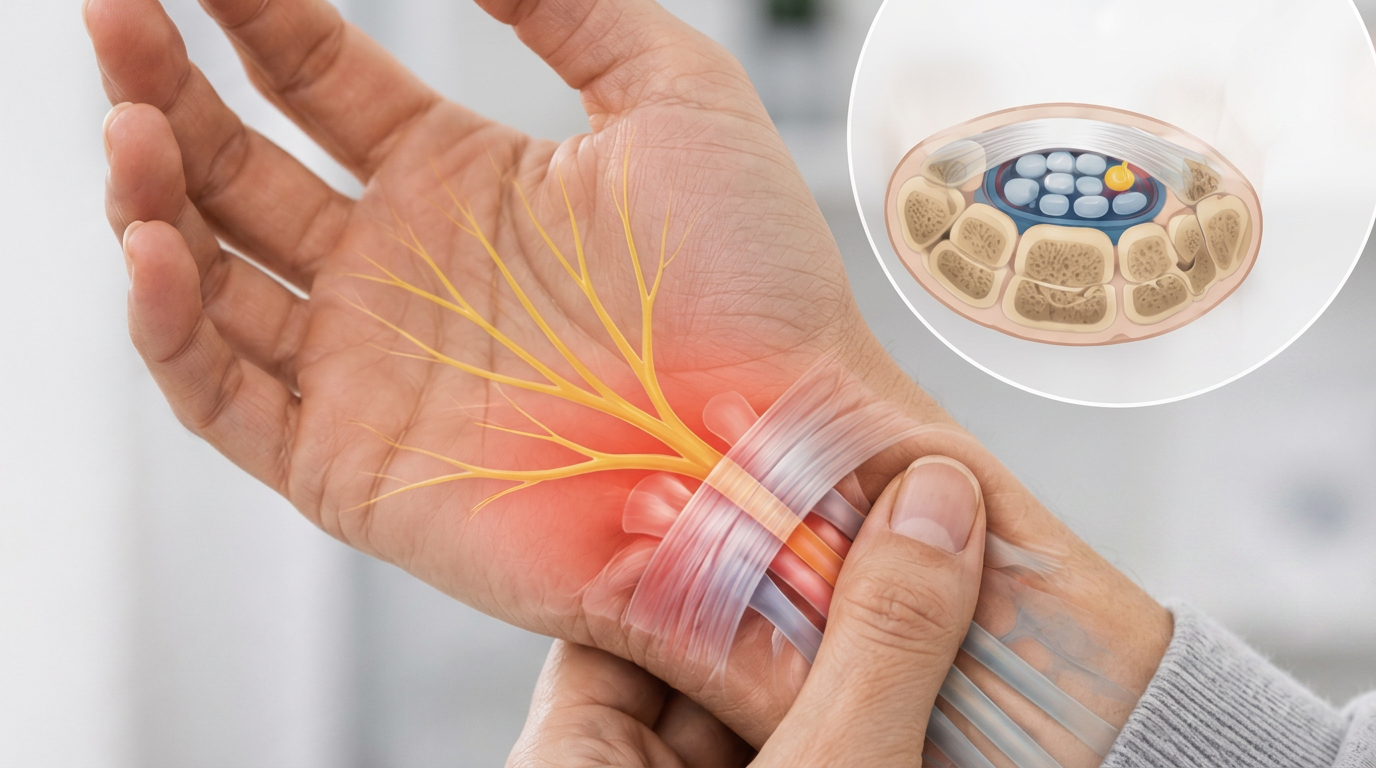
Carpal tunnel syndrome is one of the most common nerve compression conditions. It develops when the median nerve — which provides feeling to the thumb, index finger, middle finger and part of the ring finger — becomes compressed as it passes through a narrow tunnel at the wrist. Symptoms often begin gradually but, if left untreated, severe cases can lead to permanent numbness, weakness and wasting of the thumb muscles.
The good news is that most people improve with simple treatments, such as wearing a wrist splint at night, modifying aggravating activities or, when needed, receiving a steroid injection or surgery. This guide explains what carpal tunnel syndrome is, why it happens, how it is diagnosed and the evidence-based treatment options available.
Key points
- Carpal tunnel syndrome is caused by compression of the median nerve at the wrist.
- Pins and needles, numbness and night-time symptoms are the commonest features.
- Night splints are often the first treatment for mild to moderate symptoms.
- Steroid injections can provide temporary relief in selected patients.
- Surgery is highly successful when symptoms are persistent or severe.
What is carpal tunnel syndrome?
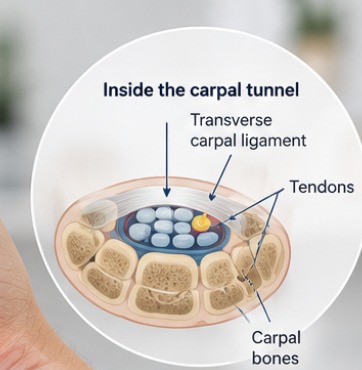
Carpal tunnel syndrome occurs when the median nerve becomes compressed inside the carpal tunnel, a narrow passageway on the palm side of the wrist.
The tunnel is formed by the wrist (carpal) bones underneath, a strong ligament called the transverse carpal ligament forming the roof, the finger flexor tendons and the median nerve itself. Because the tunnel is naturally tight, any increase in pressure within it can compress the nerve and interfere with its normal function.
Unlike tendons, nerves are very sensitive to pressure. Even relatively small increases in pressure can produce tingling, numbness and pain.
What does the median nerve do?
The median nerve supplies sensation to the thumb, index finger, middle finger and half of the ring finger. It also supplies several muscles at the base of the thumb that are responsible for gripping, pinching and fine finger movements.
If compression becomes severe or longstanding, these muscles may weaken and gradually waste away.
Symptoms
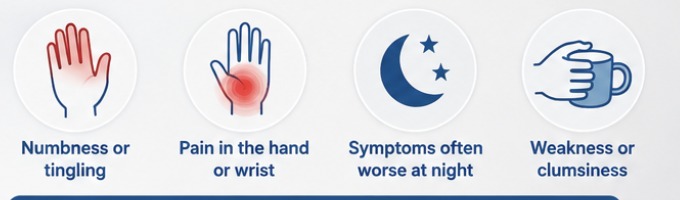
Symptoms usually develop gradually. Common symptoms include pins and needles, numbness, burning pain, an aching wrist, pain radiating into the forearm, weakness, dropping objects, reduced grip strength and clumsiness.
Symptoms typically affect the thumb, index finger, middle finger and half of the ring finger. The little finger is usually unaffected because it is supplied by a different nerve.
Night-time symptoms
One of the classic features is that symptoms are worse at night. Many patients describe waking with numb hands, shaking the hand to relieve symptoms, hanging the hand over the side of the bed, or difficulty sleeping because of tingling.
This happens because many people naturally sleep with the wrist bent, increasing pressure inside the carpal tunnel.
Daytime symptoms
Symptoms may also occur during activities involving prolonged wrist flexion, gripping or repetitive hand use. Common triggers include typing, driving, holding a phone, reading, DIY, gardening, using vibrating tools, sewing and knitting. Symptoms often improve after changing position or shaking the hand.
What causes carpal tunnel syndrome?
The underlying problem is increased pressure within the carpal tunnel. Often there is no single identifiable cause, but several factors increase the likelihood of developing CTS: pregnancy, diabetes, rheumatoid arthritis, hypothyroidism, obesity, previous wrist fracture, menopause, fluid retention, family history, repetitive gripping, vibrating tools and occupations involving prolonged wrist flexion or extension.
Many people develop carpal tunnel syndrome without any obvious trigger.
Who gets carpal tunnel syndrome?
Carpal tunnel syndrome can occur at almost any age but is most common in women between approximately 45 and 54 years, and in older men. Women are affected more commonly than men overall.
How is it diagnosed?
For most patients, the diagnosis is made from your symptoms, your medical history and a physical examination. Your clinician will ask which fingers are affected, whether symptoms wake you at night, whether shaking the hand helps and whether grip strength has reduced. The wrist, hand, neck and shoulder may also be examined to exclude other causes of arm symptoms.
Clinical tests
Your clinician may perform simple bedside tests, including Tinel's test, Phalen's test, a wrist flexion test, assessment of thumb strength and testing of sensation. These tests help reproduce symptoms by temporarily increasing pressure on the nerve.
Do I need a scan?
Usually not. Unlike many musculoskeletal conditions, MRI scans are rarely required. If the diagnosis is uncertain or surgery is being considered, nerve conduction studies may be recommended to assess how well the median nerve is functioning.
Non-surgical treatment
The majority of people with mild or moderate carpal tunnel syndrome improve without an operation. Treatment aims to reduce pressure on the median nerve, relieve pain and numbness, improve hand function and prevent permanent nerve damage.
The best treatment depends on how severe your symptoms are, how long you have had them, whether weakness or muscle wasting is present, and whether the symptoms are affecting your sleep or work.
Wrist splints
For most people with early carpal tunnel syndrome, the first treatment is a wrist splint worn at night. The splint keeps the wrist in a neutral position while you sleep, reducing pressure inside the carpal tunnel and preventing the wrist bending forwards or backwards overnight. Many patients notice improvement within several weeks.
Night splints are particularly useful if symptoms mainly occur at night, symptoms are intermittent, there is little or no muscle weakness, or symptoms have been present for only a few months.
Activity modification
Although repetitive activities do not usually cause carpal tunnel syndrome on their own, they can make symptoms worse. You may benefit from temporarily reducing prolonged gripping, forceful squeezing, repeated wrist bending, use of vibrating tools and prolonged typing without breaks.
Rather than avoiding these activities completely, it is usually better to take regular breaks, change position frequently, alternate tasks and improve workstation ergonomics.
Ergonomic advice
Simple changes at work or home can make a difference: keeping the wrists in a neutral position while typing, avoiding resting the wrist on hard edges, adjusting keyboard and mouse height, using a larger computer mouse if comfortable, taking a short break every 20–30 minutes and stretching the fingers and wrists regularly. Good ergonomics will not cure carpal tunnel syndrome, but they may reduce aggravating factors.
Physiotherapy and gliding exercises
Physiotherapy may help some people, particularly when symptoms are mild. Treatment may include education, activity advice, tendon gliding exercises, nerve gliding exercises, stretching and strengthening once symptoms improve. It is usually combined with splinting rather than replacing it.
The median nerve needs to move smoothly as the wrist and fingers move, and median nerve gliding exercises encourage this normal movement. They are performed gently and should not significantly increase symptoms; if tingling persists for a prolonged period afterwards, the exercises may need to be modified. The finger flexor tendons also pass through the tunnel, and tendon gliding exercises aim to improve tendon movement, reduce stiffness, maintain finger mobility and reduce adhesions.
Pain relief
Simple pain relief may help manage discomfort while other treatments begin to work. Depending on your medical history, your clinician may recommend paracetamol, non-steroidal anti-inflammatory drugs (NSAIDs) if appropriate, or topical anti-inflammatory gels. Painkillers help control symptoms but do not reduce pressure on the median nerve.
Steroid injections
If symptoms persist despite splinting, a corticosteroid injection into the carpal tunnel may be recommended. The injection reduces inflammation around the median nerve and surrounding tissues, and many people experience rapid improvement in numbness, less night pain, improved sleep and better hand function.
However, steroid injections are not usually a permanent cure. Symptoms may resolve completely, improve for several months, or gradually return over time. Injections are particularly useful while waiting for surgery, during pregnancy, or when symptoms are moderate but surgery is not yet appropriate.
Treatment comparison
| Treatment | Role | Advantages | Limitations |
|---|---|---|---|
| Night splint | First-line for mild to moderate symptoms | Simple, safe, no procedure | Needs consistent use; less effective if severe |
| Activity modification | Supports all other treatments | Free, reduces nerve irritation | Rarely enough on its own |
| Physiotherapy | Mild symptoms, alongside splinting | Improves nerve and tendon movement | Limited effect in severe compression |
| Steroid injection | Persistent moderate symptoms | Often rapid relief; useful in pregnancy | Temporary; symptoms may recur |
| Carpal tunnel release | Persistent, severe or progressive symptoms | High success rate; lasting relief | Surgical risks; recovery of numbness takes time |
Pregnancy and carpal tunnel syndrome
Carpal tunnel syndrome commonly develops during pregnancy, thought to be related to fluid retention, hormonal changes and increased pressure within the carpal tunnel. The reassuring news is that symptoms often improve after delivery as swelling settles. Treatment usually focuses on night splints, activity modification and reassurance, and surgery is rarely required during pregnancy unless symptoms are unusually severe.
Diabetes and carpal tunnel syndrome
People with diabetes have an increased risk of developing carpal tunnel syndrome. Good blood sugar control is important because diabetes can also affect nerve function. If surgery is required, outcomes are generally good, although recovery of sensation may take longer if diabetic neuropathy is also present.
When should I see a hand specialist?
You should seek specialist assessment if symptoms are becoming more frequent, numbness is constant rather than intermittent, you have weakness of the thumb, you frequently drop objects, splinting has not helped, symptoms interfere with work or sleep, or muscle wasting develops.
Early assessment is particularly important if weakness or permanent numbness is developing, as prolonged compression can result in irreversible nerve damage.
What happens if it is left untreated?
Mild symptoms may remain stable for some time. However, severe or persistent compression can eventually lead to permanent numbness, loss of thumb strength, wasting of the muscles at the base of the thumb (thenar wasting), reduced grip strength and difficulty performing fine tasks such as buttoning clothes or opening jars. For this reason, persistent symptoms should not simply be ignored.
When is surgery recommended?
Most people improve with non-surgical treatment. Surgery may be recommended if symptoms persist despite splinting and activity modification, steroid injections provide only temporary relief, numbness becomes constant, weakness develops, there is thenar wasting, or nerve conduction studies show significant nerve compression.
The aim of surgery is to prevent permanent nerve damage while relieving pain, numbness and tingling.
What is carpal tunnel release surgery?
Carpal tunnel release is one of the most commonly performed hand operations. The procedure involves dividing the transverse carpal ligament, which forms the roof of the carpal tunnel. Although this may sound dramatic, the ligament heals in a lengthened position, creating more space within the tunnel and reducing pressure on the median nerve.
Importantly, the nerve is not cut, the tendons are left intact, and only the tight ligament is released. Once the pressure is relieved, the nerve can begin to recover.
Open carpal tunnel release
The traditional operation is an open carpal tunnel release. A small incision is made in the palm near the wrist, the transverse carpal ligament is identified and divided, and the skin is closed with stitches. The operation usually takes around 10–20 minutes and is commonly performed under local anaesthetic, allowing you to go home the same day.
Endoscopic carpal tunnel release
Some surgeons offer an endoscopic (keyhole) carpal tunnel release, where a small camera is inserted through a tiny incision, allowing the ligament to be divided from underneath. Potential advantages include a smaller scar, less discomfort in the early recovery period and an earlier return to some activities. Long-term results are generally similar to open surgery, and the most appropriate technique depends on the surgeon's experience and your individual circumstances.
How successful is surgery?
Carpal tunnel release has an excellent success rate. For appropriately selected patients, night pain often improves within days, pins and needles usually reduce quickly, sleep improves and hand function gradually returns.
Recovery of numbness and muscle strength may take much longer, particularly if the nerve has been compressed for many months. Patients with longstanding severe compression may not regain completely normal sensation, which is one reason why surgery should not be delayed indefinitely when there is progressive weakness or muscle wasting.
Recovery after surgery
| Time | Recovery |
|---|---|
| First few days | Hand elevation, finger movement encouraged, wound care |
| 2 weeks | Stitches removed (if required), light activities resumed |
| 2–6 weeks | Gradual return to driving, office work and everyday tasks |
| 6–12 weeks | Grip strength steadily improves, heavier activities resumed |
| 3–12 months | Continued recovery of nerve function, especially numbness and strength |
Possible risks of surgery
Carpal tunnel release is a safe and commonly performed procedure, but like all operations it carries some risks: infection, bleeding, scar tenderness, temporary pillar pain (discomfort on either side of the scar), stiffness, incomplete symptom relief, recurrence and, rarely, injury to nearby nerves or blood vessels. Most complications are uncommon and the overall success rate is high.
What is the outlook?
The prognosis is generally excellent. Many people with mild symptoms improve with night splints, activity modification and avoiding prolonged wrist flexion, and symptoms may resolve completely. Moderate cases often benefit from steroid injections, physiotherapy and nerve and tendon gliding exercises, which may delay or avoid surgery.
Patients with constant numbness, thumb weakness or thenar wasting often achieve excellent pain relief from surgery, although full recovery of sensation or strength cannot always be guaranteed if compression has been longstanding.
Frequently asked questions
Will carpal tunnel syndrome go away by itself?
Some mild cases improve, particularly if symptoms are related to pregnancy or temporary swelling. Persistent symptoms should be assessed because prolonged nerve compression can lead to permanent damage.
Is typing the cause?
Typing alone is unlikely to be the sole cause of carpal tunnel syndrome. However, prolonged repetitive hand use may aggravate existing symptoms in some people.
Can I still exercise?
Yes. Most forms of exercise can continue. If certain activities worsen symptoms, temporary modification may be helpful until the nerve settles.
Can I drive?
Most people can continue driving if they can safely control the vehicle. After surgery, you should only resume driving when you can comfortably grip the steering wheel, perform an emergency stop safely and your healthcare professional agrees it is appropriate.
Will the symptoms return after surgery?
Recurrence is uncommon but can occur. Most patients experience long-term relief following successful carpal tunnel release.
The OrthoZone take-home message
Carpal tunnel syndrome is a common condition caused by compression of the median nerve at the wrist. It typically causes pins and needles, numbness and pain in the thumb, index and middle fingers, often waking people at night. Most mild cases improve with night splints and activity modification, while steroid injections or surgery may be appropriate for persistent or severe symptoms. Early diagnosis and treatment offer the best chance of preventing permanent nerve damage and restoring normal hand function.
Top tips
- Wear your night splint consistently — it is the single most effective simple treatment for early symptoms.
- Shaking the hand relieves symptoms temporarily, but persistent night waking deserves assessment.
- Take a short break and change hand position every 20–30 minutes during repetitive tasks.
- A steroid injection can buy useful relief, especially in pregnancy or while waiting for surgery.
- Seek help early if your thumb becomes weak — weakness or wasting suggests more advanced nerve compression.