
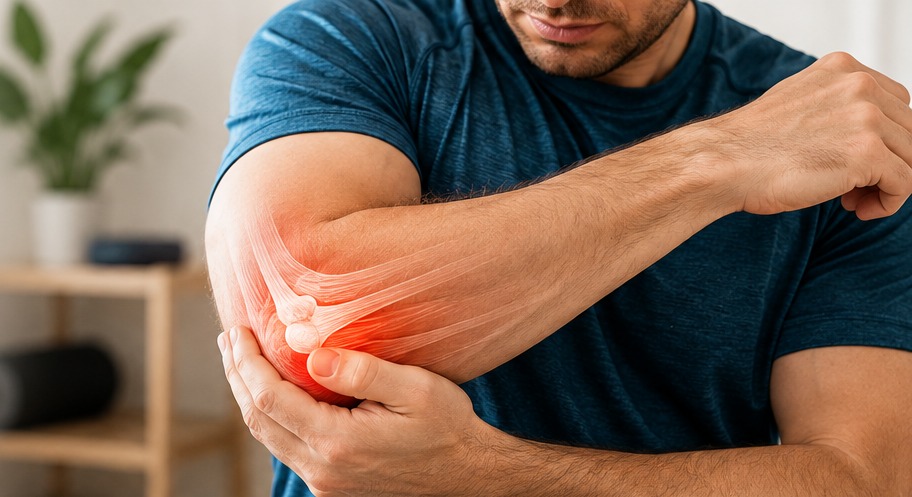
Tennis Elbow (Lateral Elbow Tendinopathy): Symptoms, Causes and Treatment
If you've developed pain on the outside of your elbow when lifting a kettle, turning a door handle, opening a jar or gripping objects, there's a good chance you have tennis elbow. Despite the name, most people who develop tennis elbow have never picked up a tennis racket.
It is one of the commonest causes of elbow pain and usually develops because the tendons on the outside of the elbow become overloaded. Repetitive gripping, lifting, DIY, gardening, manual work and computer use can all contribute.
The good news is that although tennis elbow can be extremely frustrating, it is not dangerous, and the vast majority of people recover without an operation. Modern research has also transformed how we treat it — some treatments that were once widely used, particularly steroid injections, are now known to be less effective than many people realise.
In this guide you'll learn what tennis elbow actually is, why it develops, how it is diagnosed, which treatments genuinely help, which treatments probably don't, when surgery becomes an option and how to maximise your recovery.
Key points
- Tennis elbow affects the tendons on the outside of the elbow, not the elbow joint itself.
- Less than 10% of people develop it because of playing tennis; repetitive gripping and lifting are much more common causes.
- Around 80–90% of people improve naturally over one to two years, although many recover much sooner.
- Progressive exercise and physiotherapy have the strongest evidence for improving symptoms.
- Surgery is rarely required and should only be considered after prolonged failure of well-managed non-operative treatment.
What is tennis elbow?
Tennis elbow is the common name for a condition doctors now usually call lateral elbow tendinopathy. Older medical textbooks often referred to it as lateral epicondylitis, implying inflammation ("-itis"). We now know this isn't quite accurate.
Instead of being a problem caused mainly by inflammation, tennis elbow is thought to result from changes within the tendon itself caused by repeated overload. The tendon develops microscopic damage and loses its normal structure, making it painful and less able to tolerate everyday activities.
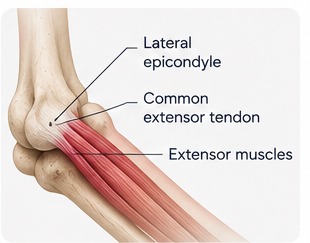
The tendon most commonly involved is the common extensor tendon, which attaches several muscles of the forearm to the bony prominence on the outside of the elbow called the lateral epicondyle. These muscles lift the wrist, straighten the fingers and stabilise the wrist while gripping.
Every time you hold a shopping bag, use a screwdriver, type on a keyboard or shake someone's hand, these muscles work continuously. When they become overloaded over weeks or months, the tendon can become painful.
Why is it called tennis elbow?
The name is actually quite misleading. Although tennis players can certainly develop the condition, fewer than one in ten cases are related to racket sports. Far more commonly it affects people who repeatedly use their hands during everyday life.
Typical occupations include plumbers, electricians, mechanics, carpenters, decorators, gardeners, builders, chefs and office workers using a mouse for prolonged periods.
DIY projects are another classic trigger. Many people spend an entire weekend painting ceilings, laying flooring or building a shed before noticing elbow pain several days later.
How common is tennis elbow?
Tennis elbow is extremely common. It affects around 1–3% of adults every year and is most frequently seen between the ages of 35 and 55 years. Men and women are affected equally.
Although anyone can develop tennis elbow, certain activities increase the risk: repetitive gripping, repetitive twisting, forceful lifting, manual work, repetitive computer use, racket sports and throwing sports. Sometimes there is no obvious cause at all.
Understanding the tendon: why does it hurt?
One of the biggest misconceptions about tennis elbow is that the tendon has become "torn". In reality, the changes are usually much more subtle.
A healthy tendon is made of tightly organised collagen fibres that efficiently transmit force from muscle to bone. When repeatedly overloaded, tiny microscopic changes begin to develop. Rather than healing perfectly each time, the tendon gradually becomes disorganised: the collagen fibres become less well aligned, small blood vessels and nerve fibres grow into the tendon, and the tendon becomes more sensitive.
Importantly, this does not mean the tendon is permanently damaged. Tendons have an incredible ability to remodel themselves when loaded appropriately. This is why carefully graded strengthening exercises form the foundation of modern treatment.
What does tennis elbow feel like?
The symptoms usually develop gradually rather than after one specific injury. Most people describe pain on the outside of the elbow, tenderness over the bony prominence, pain spreading into the upper forearm, discomfort when gripping objects, difficulty opening jars, pain lifting a kettle, pain carrying shopping bags, discomfort turning keys or door handles, pain shaking hands and reduced grip strength.
Many people also notice stiffness first thing in the morning. One of the hallmark features is pain when lifting something with the palm facing down — this position places the greatest load through the common extensor tendon.
How is tennis elbow diagnosed?
One of the reassuring things about tennis elbow is that it can usually be diagnosed from your symptoms and a simple examination. Most people do not need an X-ray, ultrasound or MRI scan.
Your clinician will ask where exactly the pain is, when it began, whether there was a particular injury, what activities make it worse, what sort of work or sport you do, and whether you have noticed any weakness or numbness. The pattern of symptoms often provides the biggest clue.
Physical examination
During the examination, your clinician will assess the exact location of your pain, tenderness over the lateral epicondyle, pain during resisted wrist extension, pain when gripping, movement of the elbow and wrist, and movement of the neck and shoulder if required.
One of the most common examination findings is pain when you try to lift your wrist against resistance while keeping your elbow straight. This places tension through the common extensor tendon and reproduces the symptoms.
Do I need an MRI scan?
Usually not. Imaging is generally reserved for situations where symptoms have persisted despite appropriate treatment, the diagnosis is uncertain, another injury is suspected or surgery is being considered.
If imaging is performed, ultrasound may demonstrate changes within the common extensor tendon, while MRI provides more detailed information and may show degeneration or partial tearing within the tendon.
Importantly, scans should always be interpreted alongside your symptoms. Many people have tendon abnormalities on imaging without pain, while others experience significant symptoms despite relatively modest scan findings. Treatment should focus on your symptoms and function, rather than the scan alone.
Could it be something else?
Although tennis elbow is common, pain around the elbow can sometimes have other causes. Your clinician may also consider radial tunnel syndrome, arthritis of the elbow, neck pain causing referred symptoms, ligament injuries, tendon tears, inflammatory arthritis and nerve compression.
If you develop significant numbness, weakness in the hand, loss of movement, swelling, redness or fever, you should seek medical assessment promptly, as these symptoms are not typical of uncomplicated tennis elbow.
Does tennis elbow heal by itself?
Fortunately, yes. This is one of the most encouraging aspects of the condition. Research suggests that around 80–90% of people improve over one to two years without surgery, although many recover much sooner with appropriate treatment.
However, waiting for symptoms to settle without changing anything may mean recovery takes longer than necessary. Modern rehabilitation aims to reduce pain, improve tendon strength, restore grip strength, improve function and help you return to normal activities sooner.
Treatment of tennis elbow
The aim of treatment is not simply to reduce pain, but to help the tendon recover and become more resilient. The majority of patients improve without injections or surgery. Treatment usually involves a combination of education, activity modification, progressive exercise, pain management and physiotherapy.
Understanding tendon loading
One of the most important concepts in tennis elbow treatment is understanding how tendons respond to load. Think of your tendon like a rope. A healthy rope easily tolerates repeated pulling. If you suddenly ask it to cope with much heavier loads than usual, tiny areas of damage develop.
The solution is not complete rest forever. Instead, the tendon needs carefully controlled loading that stimulates healing without overwhelming it. This is exactly what progressive rehabilitation aims to achieve.
Activity modification
This is often one of the most effective early treatments. The goal is not to stop using your arm completely, but to reduce the activities that repeatedly overload the tendon while it settles.
Helpful changes may include taking regular breaks from repetitive tasks, avoiding prolonged forceful gripping, reducing heavy lifting temporarily, sharing large DIY projects over several days rather than one weekend, adjusting sporting technique, using larger racket grips where appropriate and improving workstation ergonomics.
NHS guidance also recommends building up new activities gradually and ensuring good technique, particularly for racquet sports and manual work.
Physiotherapy
Physiotherapy is one of the most effective treatments for persistent tennis elbow. The main aims are to improve tendon capacity, restore forearm strength, improve grip strength, reduce pain, improve function and prevent recurrence. Modern rehabilitation focuses on progressive strengthening, rather than prolonged rest.
Eccentric and progressive exercises
The strongest evidence supports a structured strengthening programme that progressively loads the tendon. Historically, much attention has focused on eccentric exercises, where the muscle lengthens while under tension. These exercises help stimulate tendon remodelling and improve its ability to tolerate load over time, and NHS patient information specifically recommends them as part of management.
Today, many physiotherapists combine eccentric, concentric and isometric exercises into a graduated programme, progressing according to symptoms and function.
Stretching
Gentle stretching of the wrist extensor muscles may help reduce stiffness and improve flexibility. Stretching is usually most effective after activity, after strengthening exercises and as part of a broader rehabilitation programme. Stretching alone is unlikely to resolve tennis elbow but can complement strengthening.
Can I keep exercising?
Yes. In most cases, complete rest is not recommended. Instead, reduce activities that significantly increase pain, continue exercising the rest of your body, gradually reintroduce upper-limb loading and follow your rehabilitation programme consistently.
Many people continue activities such as walking, cycling, lower-body gym work and swimming (if comfortable) while modifying activities that provoke elbow pain.
Braces, pain relief and other treatments
Braces and supports
Counterforce braces are designed to reduce the load transmitted through the common extensor tendon during gripping activities. Some people find they reduce pain during activity, improve confidence and make work or sport more comfortable.
However, braces should be viewed as a temporary aid, rather than a long-term solution — strengthening the tendon remains the most important treatment. NHS guidance notes that these braces can help reduce symptoms during activity and are widely available.
Pain relief
Pain relief may help you stay active while completing rehabilitation. Options include paracetamol, topical anti-inflammatory gels and oral anti-inflammatory medication where appropriate. NHS guidance also recommends applying an ice pack for around 15 minutes after activities that provoke symptoms.
Medication should be viewed as a way of supporting rehabilitation rather than replacing it.
Ice or heat?
Ice may be helpful after activities that aggravate symptoms and during painful flare-ups. Heat may be useful before exercise, before stretching and when stiffness is the main problem. Neither treatment repairs the tendon, but both may provide temporary symptom relief.
Massage
Gentle massage over the forearm muscles may help reduce muscle tension and improve comfort. However, massage does not reverse the underlying tendon changes and should be considered an adjunct rather than a primary treatment.
Injections and other procedures
Corticosteroid injections
For many years, corticosteroid (cortisone) injections were one of the most common treatments for tennis elbow. The aim of the injection is to reduce pain by decreasing inflammation around the tendon. Although many people experience rapid pain relief, our understanding of tennis elbow has changed considerably.
Modern research has shown that steroid injections often provide good short-term relief but may be associated with poorer long-term outcomes and higher recurrence rates compared with exercise-based rehabilitation. NHS guidance also notes potential complications, including tendon rupture and skin or fat atrophy around the injection site.
For this reason, corticosteroid injections are no longer recommended as routine first-line treatment for most patients. They may still have a role in carefully selected individuals — for example when severe pain is preventing participation in rehabilitation — but they should generally be viewed as a way of temporarily reducing pain rather than curing the underlying tendon problem.
Platelet-rich plasma (PRP)
Platelet-rich plasma has become increasingly popular over the last decade. A small sample of your blood is taken, spun in a centrifuge, and the platelet-rich portion is injected into the damaged tendon. Platelets contain growth factors that may encourage tendon healing.
Although this sounds promising, the current evidence remains mixed. Some studies suggest modest improvements in selected patients, while others show little difference compared with placebo or structured rehabilitation. At present, there is insufficient high-quality evidence to recommend PRP routinely for tennis elbow.
If you are considering private PRP treatment, it is important to understand that treatment can be expensive, protocols vary considerably, results cannot be guaranteed, and exercise-based rehabilitation remains essential regardless of whether an injection is performed.
Shockwave therapy
Extracorporeal shockwave therapy (ESWT) delivers controlled sound waves into the painful tendon. The treatment is thought to stimulate biological healing and alter pain signalling within the tendon.
Current evidence suggests that shockwave therapy may benefit some patients with persistent tennis elbow, particularly when symptoms have lasted several months despite appropriate rehabilitation. However, improvements are often gradual, multiple treatment sessions are usually required and not everybody responds. It should usually be considered an addition to a strengthening programme rather than a replacement for one.
Dry needling
Some physiotherapists and sports medicine clinicians offer dry needling, which involves placing very fine needles into the affected tendon or surrounding muscles. Although some patients experience temporary pain relief, the evidence remains variable and it should be viewed as an adjunct rather than a primary treatment.
Does surgery ever become necessary?
Fortunately, surgery is rarely required. Most people improve with education, activity modification, physiotherapy and progressive strengthening.
Surgery is usually considered only when symptoms have persisted for 6–12 months or longer, comprehensive non-operative treatment has failed, pain continues to interfere significantly with work or daily life, and the diagnosis is clear with other causes of elbow pain excluded. Only a small proportion of patients ultimately require surgery.
What does surgery involve?
Several operations have been described, but the overall aim is similar: remove degenerative tendon tissue, stimulate healing, reduce tension through the common extensor tendon and preserve healthy tendon where possible.
The procedure may be performed through a small open incision, arthroscopically (keyhole surgery) or using a mini-open technique. Most operations are carried out as day-case procedures.
After surgery, rehabilitation remains extremely important. Simply having the operation without rebuilding tendon strength is unlikely to produce the best possible result.
| Time | Recovery goals |
|---|---|
| First 2 weeks | Wound healing, gentle movement, pain control |
| 2–6 weeks | Gradually increasing elbow movement and beginning light strengthening |
| 6–12 weeks | Progressive strengthening and return to light work |
| 3–6 months | Return to heavier activities and most sports |
| 6–12 months | Continued tendon remodelling and improvement in strength |
Even after surgery, tendons continue to remodel for many months.
What is the outlook?
The prognosis for tennis elbow is generally excellent. Most people recover with time and appropriate rehabilitation.
Factors associated with better outcomes include remaining active, following a structured strengthening programme, modifying aggravating activities, avoiding repeated overload during early recovery and gradually returning to work and sport.
Symptoms often improve steadily rather than disappearing overnight. It is common to experience occasional flare-ups, particularly after an unusually heavy day of gripping or lifting — this does not necessarily mean that damage has occurred.
Treatment comparison
| Treatment | Role | Advantages | Limitations |
|---|---|---|---|
| Education | Understanding the condition | Improves confidence and self-management | Requires active participation |
| Activity modification | Reduce tendon overload | Often produces early symptom improvement | Temporary lifestyle adjustments |
| Physiotherapy | Improve tendon capacity | Strongest long-term evidence | Requires consistency |
| Strengthening exercises | Promote tendon remodelling | Addresses the underlying problem | Improvement takes time |
| Counterforce brace | Reduce symptoms during activity | Helpful for some people | Does not treat the tendon |
| Pain medication | Temporary symptom relief | Supports rehabilitation | Does not repair the tendon |
| Steroid injection | Short-term pain reduction | May help selected patients | Higher recurrence and potential complications |
| Shockwave therapy | Persistent cases | May benefit selected patients | Variable response |
| PRP | Experimental option | Possible benefit in some patients | Evidence remains inconsistent |
| Surgery | Persistent severe symptoms | May improve pain and function | Required only in a small minority |
Frequently asked questions
Should I rest my arm completely?
No. Complete rest usually leads to further weakness. Instead, modify painful activities while continuing with your rehabilitation programme.
Is tennis elbow actually inflammation?
Not usually. Current evidence suggests that tennis elbow is primarily a degenerative tendinopathy rather than an inflammatory condition, which is why strengthening exercises are so important.
Will it heal without treatment?
Many people improve naturally over time. However, structured rehabilitation often helps reduce symptoms sooner and improves long-term function.
Can I continue playing tennis?
Usually yes. You may need to temporarily reduce playing time, improve technique, modify racket grip size and gradually increase activity again as symptoms improve. Stopping all sport completely is rarely necessary.
Should I wear a brace?
A counterforce brace may reduce symptoms during activity. However, it should complement physiotherapy rather than replace it.
Will I need surgery?
Probably not. The vast majority of people recover without an operation.
The OrthoZone take-home message
Tennis elbow is one of the most common tendon problems affecting the upper limb. Despite its name, it usually has nothing to do with tennis and instead develops because the common extensor tendon becomes overloaded. The vast majority of people recover without surgery. Modern treatment focuses on education, activity modification and progressive strengthening to restore the tendon's ability to tolerate everyday loads. While injections and other treatments may have a role in selected cases, a structured rehabilitation programme remains the foundation of successful recovery.
Top tips
- Keep using your arm — but avoid repeatedly provoking severe pain. Complete rest usually delays recovery.
- Progressive strengthening is the most important long-term treatment. Tendons become stronger by being loaded appropriately, not by avoiding all activity.
- Modify the activity, not your life. Breaking large DIY jobs into smaller sessions or changing your technique can make a significant difference.
- Be cautious about quick fixes. Steroid injections may reduce pain temporarily but are not usually the best long-term solution.
- Be patient. Tendons heal slowly — improvement is usually measured over weeks to months rather than days.