Olecranon Bursitis (Student's Elbow): A Complete Guide to Swelling Behind the Elbow
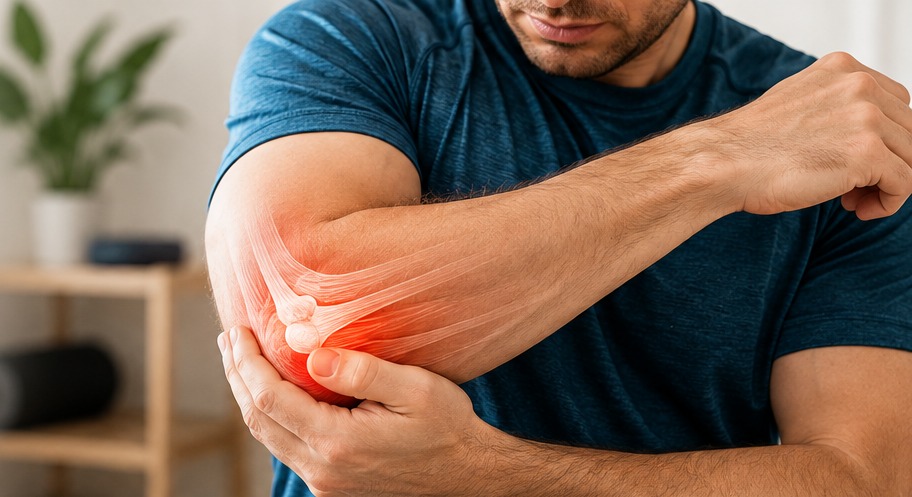
Finding a soft lump over the back of your elbow can be alarming. Many people worry they have broken a bone, developed arthritis or even a tumour. Fortunately, one of the commonest causes is olecranon bursitis, a condition affecting the small fluid-filled sac that lies between the skin and the point of the elbow.
Olecranon bursitis often develops after repeated pressure on the elbow, a direct knock or occasionally because of an underlying medical condition such as gout or rheumatoid arthritis. Sometimes the swelling becomes infected, making prompt medical assessment important.
The good news is that most cases are not infected and settle without surgery. Understanding the difference between simple bursitis and an infected bursa is the key to choosing the right treatment.
In this guide we'll explain what olecranon bursitis is, why it develops, how it is diagnosed and the treatments that are most likely to help.
Key points
- Olecranon bursitis causes swelling over the point of the elbow due to inflammation of the small fluid-filled bursa that sits between the bone and the skin.
- Most cases are caused by repeated pressure, leaning on the elbow or a minor injury rather than a serious problem.
- Around one in five cases of acute olecranon bursitis may be infected, making it important to recognise warning signs such as redness, warmth and increasing pain.
- Most non-infected bursae improve with rest, ice, compression and avoiding repeated pressure.
- Surgery is only required for a small number of people with persistent or recurrent symptoms after non-operative treatment has failed.
Understanding the elbow
The elbow is formed where three bones meet: the humerus (upper arm bone), the ulna and the radius.
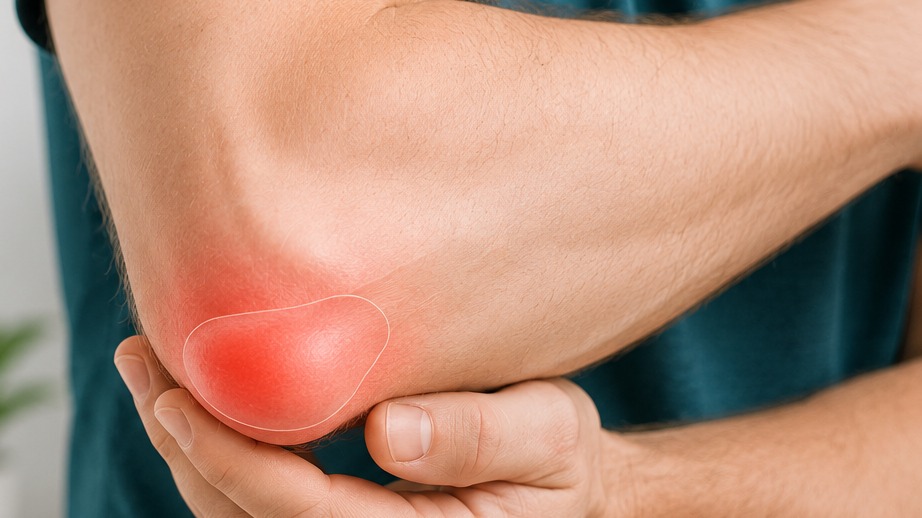
At the very back of the elbow is the olecranon, the prominent point that you can easily feel beneath the skin. Unlike many other parts of the body, there is very little soft tissue covering this bone. Instead, a small fluid-filled sac called the olecranon bursa sits between the bone and the skin.
Its job is surprisingly simple. It allows the skin to glide smoothly over the bone whenever you bend or straighten your elbow. Without it, everyday movements would create much more friction.
Normally this bursa is extremely thin and you are usually unaware that it is even there. Problems develop when the bursa becomes irritated and begins producing excess fluid.
What is olecranon bursitis?
Olecranon bursitis simply means inflammation and swelling of the bursa over the tip of the elbow. As the lining of the bursa becomes irritated, it starts producing extra fluid. The bursa gradually enlarges, creating the characteristic soft swelling behind the elbow.
For some people this swelling is only a minor nuisance. For others it can become large enough to interfere with everyday activities such as leaning on a desk, driving, gardening, lifting, exercising or wearing long-sleeved clothing.
Interestingly, the size of the swelling does not always reflect how painful it is. Many patients have a large swelling with very little discomfort, while others develop a smaller but much more painful bursa, particularly if infection or gout is present.
Why does the bursa become inflamed?
The bursa is designed to reduce friction. However, if it is repeatedly compressed or injured, it can become irritated and begin producing excess fluid.
Think of it like repeatedly rubbing the same area of skin. Initially nothing happens. Eventually the tissues become irritated and swollen. The olecranon bursa behaves in much the same way. The swelling is therefore a response to irritation rather than the primary problem itself.
What causes olecranon bursitis?
Repeated pressure
This is by far the commonest cause. People who spend long periods leaning on hard surfaces are particularly prone — office workers, students, mechanics, plumbers, electricians, carpet fitters and gardeners.
This explains why olecranon bursitis is sometimes known as Student's Elbow or Miner's Elbow.
Direct trauma
A single knock to the point of the elbow can trigger inflammation. You may notice swelling developing over several hours or days after falling onto the elbow, bumping the elbow against a door frame or a sporting injury. Sometimes the swelling appears surprisingly large despite only a relatively minor injury.
Infection (septic bursitis)
Sometimes bacteria enter the bursa through a small cut, an abrasion, cracked skin or an insect bite. Once bacteria enter the bursa, infection develops. This is known as septic olecranon bursitis.
Recognising this is extremely important because infected bursitis requires prompt medical treatment with antibiotics, and sometimes drainage of the infected fluid.
Gout
Gout is another important cause. In gout, tiny uric acid crystals collect inside the bursa, triggering inflammation. Patients often notice rapid swelling, pain, redness and tenderness. Gout may be suspected if you have previously experienced attacks affecting the big toe, ankle or knee.
Rheumatoid arthritis and other inflammatory conditions
Inflammatory arthritis can also involve the olecranon bursa. Although less common, patients with rheumatoid arthritis sometimes develop persistent elbow swelling as part of their underlying condition.
Is it always painful?
Surprisingly, no. Many people expect a swollen elbow to be extremely painful. In reality, non-infected olecranon bursitis is often almost painless, and the swelling itself is frequently the biggest concern.
Pain becomes much more likely when the bursa is infected, gout is present, the swelling is under significant tension, or the elbow has recently been injured. Infected bursae are almost always painful, whereas non-infected bursitis is painful in fewer than 25% of cases.
What are the symptoms?
Typical symptoms include a soft lump over the point of the elbow, swelling that gradually enlarges, discomfort when leaning on the elbow, pain bending the elbow fully, tenderness over the swelling and a reduced ability to rest the elbow on hard surfaces.
Many patients notice that straightening the elbow is comfortable, but bending it beyond about 90 degrees becomes increasingly uncomfortable because the enlarged bursa becomes compressed.
Septic versus non-septic olecranon bursitis
One of the most important decisions your clinician has to make is whether the swelling is infected (septic) or non-infected (aseptic). Although both conditions cause swelling, they are treated very differently.
| Feature | Non-septic bursitis | Septic bursitis |
|---|---|---|
| Onset | Swelling develops gradually | Rapidly increasing swelling |
| Skin | Usually normal in appearance | Red and warm |
| Pain | Often little or none | Significant tenderness, pain even at rest |
| How you feel | Generally well | Fever or feeling generally unwell |
| History | Repeated pressure or a recent knock | A recent cut, graze or puncture wound over the elbow |
How is olecranon bursitis diagnosed?
In most cases, diagnosis is straightforward. Your clinician will ask when the swelling started, whether there has been an injury, whether you lean on your elbows regularly, whether the swelling is painful, whether you have had a fever, and about any history of gout or rheumatoid arthritis.
The elbow will then be examined to assess the size of the swelling, tenderness, redness, warmth, elbow movement and any signs suggesting infection. Often, this is enough to make the diagnosis.
Do I need any tests?
Most people do not need scans. However, further investigations may sometimes be useful if another diagnosis is suspected. These may include X-rays if a fracture, bone spur or arthritis is suspected; blood tests if gout, rheumatoid arthritis or infection is being considered; and aspiration, where fluid is removed from the bursa using a needle if infection is suspected or the diagnosis is unclear.
Importantly, aspiration is not routinely needed for every swollen elbow. It is generally reserved for situations where the result is likely to influence treatment.
Treatment of olecranon bursitis
The good news is that most cases of olecranon bursitis improve without surgery. The treatment depends on one key question: is the bursa infected or not?
This is the single most important decision because the treatments are very different. If the swelling is not infected, treatment is usually simple and focuses on allowing the irritated bursa to settle. If the bursa is infected, antibiotics and sometimes drainage become necessary. Understanding this difference helps explain why some patients simply need an elbow pad, while others require urgent medical treatment.
Stage 1 — is it septic or non-septic?
Your clinician first decides whether infection is likely. Features suggesting infection include redness, warmth, increasing pain, fever, rapidly enlarging swelling, or a cut or graze over the elbow. If infection is suspected, aspiration and antibiotics are often required rather than simply observing the swelling.
Stage 2 — protect the bursa
If infection is not suspected, the first goal is reducing irritation. The inflamed bursa behaves rather like a blister: every time it is compressed against a hard surface it becomes more irritated and produces more fluid. Treatment therefore focuses on preventing repeated compression while the inflammation settles.
Stage 3 — allow the swelling to resolve
Most bursae gradually reabsorb the excess fluid naturally. This may take several weeks, or occasionally a couple of months. Most cases settle within approximately two months. Although the swelling often reduces steadily, a small amount of thickening may persist for longer.
Stage 4 — prevent recurrence
Once symptoms improve, attention turns to preventing the problem returning. This usually means avoiding prolonged pressure, modifying work activities, using elbow protection, and treating underlying conditions such as gout where appropriate.
Rest doesn't mean complete immobilisation
Many people think they should keep the elbow completely still. Fortunately, this is rarely necessary. Instead, avoid repeatedly leaning on the elbow, avoid repetitive heavy loading during painful flare-ups, and continue gently moving the elbow several times each day.
Gentle bending and straightening helps maintain movement while allowing the inflamed tissues to recover.
Ice
Ice is often one of the simplest treatments. Applying an ice pack for approximately 10 minutes every few hours may help reduce pain and swelling. Always wrap the ice in a towel rather than placing it directly onto the skin.
Ice is particularly useful during the first few days, after aggravating activities and following a knock to the elbow.
Compression
Compression helps reduce swelling by limiting the amount of fluid accumulating within the bursa. Common options include Tubigrip, elastic compression bandages and padded elbow sleeves.
Compression should feel supportive but should not cause numbness, tingling, colour change or excessive tightness. If aspiration has been performed, compression becomes even more important because it helps reduce the chance of the fluid immediately returning.
Elbow pads
One of the simplest and most effective long-term treatments is an elbow pad. Think of it as protecting the bursa from repeated minor injuries. An elbow pad is particularly useful for office workers, mechanics, plumbers, electricians, gardeners and people who regularly lean on desks.
Even placing a folded towel beneath the elbow while working can make a noticeable difference.
Activity modification
Most people recover more quickly if they temporarily reduce the activities that repeatedly irritate the bursa. Helpful changes include avoiding leaning on hard desks, changing arm position regularly, avoiding crawling on the elbows, taking regular breaks during repetitive work and using cushioning where possible.
The aim is not to stop using the arm completely, but simply to reduce repeated compression.
Pain relief
Pain relief may help during the early stages. Options include paracetamol and anti-inflammatory medication such as ibuprofen if appropriate. These medicines may reduce discomfort and allow normal movement while the inflammation settles.
Anti-inflammatory medication may not be suitable for everyone, particularly those with stomach ulcers, kidney disease or certain heart conditions. Always follow the advice of your pharmacist or doctor.
When is aspiration needed?
One of the commonest questions patients ask is: "Can't you just drain it?" The answer is sometimes — but not always.
Aspiration involves placing a needle into the bursa and removing the fluid. It may be considered when infection is suspected, the swelling is very large, the swelling is causing significant functional problems, or the diagnosis is uncertain.
However, aspiration is not routinely recommended for every swollen elbow, because the fluid often comes straight back, introducing a needle creates a small risk of infection, and many bursae settle naturally without drainage. Aspiration is commonly performed immediately when infection is suspected so the fluid can be analysed.
Why doesn't everyone have their bursa drained?
It seems logical that removing the fluid would solve the problem. Unfortunately, it often doesn't. The bursa continues to produce fluid until the underlying inflammation settles.
Draining it may temporarily reduce the swelling, but without treating the cause the fluid frequently returns, repeated aspirations may become necessary, and infection risk increases slightly each time. For this reason, aspiration is generally reserved for selected patients rather than being routine.
Corticosteroid injections
Steroid injections may reduce inflammation within the bursa. They can sometimes be considered when symptoms persist, infection has been confidently excluded and swelling is affecting daily activities.
However, there are important downsides. Although steroid injections may reduce recurrence in some patients, they also increase the risk of infection, and they should never be injected into a septic (infected) bursa. For this reason, steroid injections are used much more selectively than many patients expect.
Septic olecranon bursitis
An infected bursa requires prompt treatment. Unlike simple bursitis, this is not something that should simply be observed. Treatment usually includes antibiotics, aspiration to obtain fluid for laboratory testing when appropriate, compression after drainage where suitable, and occasionally admission to hospital for intravenous antibiotics if the infection is severe.
Delaying treatment increases the risk of the infection spreading into the surrounding soft tissues or deeper structures.
Can infection spread into the joint?
Fortunately, the elbow joint itself lies deep to the bursa. This means infection within the bursa does not automatically mean the elbow joint is infected. However, untreated infection can spread, which is why increasing redness, fever or worsening pain should always be assessed urgently.
When is surgery needed?
Fortunately, surgery is rarely necessary. Most people improve with avoiding pressure, compression, ice and activity modification.
Surgery may be considered if swelling repeatedly returns, symptoms persist despite appropriate treatment, there is chronic troublesome bursitis, recurrent infection develops, or the swelling significantly interferes with work or daily activities. The operation usually involves removing the entire bursa (bursectomy).
What happens during surgery?
The surgeon removes the thickened bursa through an incision over the back of the elbow. The body naturally forms a new, healthy bursa over time.
Although surgery is generally successful, patients should understand that wound healing can sometimes be slow because the skin over the elbow is thin, a period of reduced elbow movement may be recommended afterwards, and recurrence remains possible although uncommon. Wound healing may occasionally take up to three months, and surgery does not completely eliminate the risk of recurrence.
Recovery
The outlook for most people with olecranon bursitis is excellent. Unlike many tendon or joint conditions, the problem is often self-limiting, meaning it settles gradually once the irritation has been removed.
Most uncomplicated, non-infected bursae improve within 6–8 weeks, although larger swellings may take several months to completely disappear; most cases resolve without complications within approximately two months.
One important thing to remember is that the swelling often improves before the bursa has completely returned to normal. Some people are left with a small, painless thickening over the point of the elbow. Provided it is not painful or infected, this usually does not require treatment.
| Time | What to expect |
|---|---|
| First few days | Reduce pressure on the elbow, use ice and compression, begin gentle movement. |
| 1–2 weeks | Pain often begins to improve. Swelling may remain but should gradually stabilise. |
| 2–6 weeks | Most non-infected bursae become progressively smaller. Normal daily activities usually become easier. |
| 6–8 weeks | Many patients have little or no pain, although a small swelling may still be visible. |
| 2–6 months | Larger bursae may continue shrinking gradually. Persistent thickening is common but often causes no symptoms. |
| After surgery | Initial wound healing usually occurs within a few weeks, although complete recovery and remodelling can take several months. Occasionally wound healing is prolonged because of the thin skin over the elbow. |
Can olecranon bursitis come back?
Yes. Recurrence is one of the commonest concerns. If the original cause continues — for example leaning on hard desks, repetitive crawling, frequent knocks to the elbow or untreated gout — the bursa may become inflamed again.
Fortunately, recurrence can often be prevented by avoiding prolonged pressure, using elbow pads, modifying work activities and treating any underlying medical conditions. Patients who understand why the bursa became inflamed are generally much less likely to experience repeated episodes.
Treatment comparison
| Treatment | Purpose | Advantages | Limitations |
|---|---|---|---|
| Rest and activity modification | Reduce irritation | First-line treatment for most patients | Requires avoiding pressure on the elbow |
| Ice | Reduce pain and swelling | Simple and inexpensive | Temporary symptom relief |
| Compression bandage or elbow sleeve | Limit fluid accumulation | May reduce swelling and recurrence | Must not be excessively tight |
| Elbow pad | Protect the bursa from pressure | Very effective for work-related cases | Must be worn consistently |
| Pain relief | Control discomfort | Allows normal movement to continue | Not suitable for everyone |
| Aspiration | Remove fluid and test for infection | Useful when infection is suspected | Fluid often returns; small infection risk |
| Corticosteroid injection | Reduce persistent inflammation | May reduce recurrence in selected patients | Increases infection risk; never used in a septic bursa |
| Antibiotics | Treat septic bursitis | Essential when infection is present | No benefit for non-infected bursitis |
| Surgery (bursectomy) | Chronic or recurrent bursitis | Removes the persistently inflamed bursa | Wound healing can be slow; rarely needed |
Frequently asked questions
Should I massage the swelling?
No. Massage is unlikely to help and may actually increase irritation. The problem lies within the inflamed bursa itself rather than tight muscles surrounding it.
Can I exercise?
Yes. Most people can continue walking, cycling, lower-body gym work and gentle upper-limb exercises, provided they avoid repeatedly leaning on the elbow or placing direct pressure over the swelling. Gentle elbow bending and straightening should continue throughout recovery to prevent stiffness.
Should I keep draining it?
Usually not. Although aspiration can reduce swelling temporarily, the fluid frequently returns because the inflamed lining continues producing fluid until the underlying irritation settles. Repeated aspirations also carry a small risk of introducing infection, so aspiration is generally reserved for carefully selected situations.
Is it safe to ignore a swollen elbow?
Sometimes. If the swelling is painless, not red, not hot, not getting larger and not affecting function, simple observation may be appropriate. However, increasing pain, redness or warmth should always prompt medical assessment because infection must be excluded.
Will it burst?
This is a surprisingly common worry. Although the skin may feel stretched, the bursa itself does not usually "burst". However, very large swellings are more vulnerable to knocks, skin breakdown and infection, which is another reason to protect the elbow from repeated trauma.
Does everyone need antibiotics?
No. Antibiotics are only indicated if infection is suspected or confirmed. Taking antibiotics for a simple, non-infected bursa will not speed recovery.
Can I lean on my elbow once it has healed?
Yes — but moderation is important. If prolonged pressure caused the problem in the first place, using an elbow pad or changing your working position can help prevent recurrence.
When should you seek urgent medical advice?
Seek prompt medical assessment if you develop rapidly increasing swelling, severe pain, redness spreading around the elbow, warmth over the swelling, fever or feeling generally unwell, pus or fluid leaking from the skin, an inability to move the elbow because of pain, or a swollen elbow after a penetrating injury.
Patients with diabetes, kidney disease, immune suppression or those taking steroid medication should seek assessment earlier because infection may progress more quickly.
The OrthoZone take-home message
Olecranon bursitis is a common and usually harmless cause of swelling over the point of the elbow. The most important step is deciding whether the bursa is infected, because infected bursae need prompt antibiotic treatment while non-infected bursae usually settle with simple measures. Protecting the elbow from repeated pressure, using ice and compression, keeping the elbow moving and being patient will resolve the great majority of cases without any need for drainage or surgery.
Top tips
- Protect the point of the elbow — an elbow pad or even a folded towel under the elbow at a desk removes the repeated pressure that caused the problem.
- Don't assume every swollen elbow is infected. Many bursae are painless and settle naturally; however, increasing redness, warmth or fever requires urgent assessment.
- Keep the elbow moving. Gentle bending and straightening several times a day helps maintain normal movement while the swelling settles.
- Draining the bursa isn't always the answer — the fluid often returns until the underlying irritation has settled.
- Treat the cause, not just the swelling: modify work positions and manage conditions such as gout to prevent recurrence.