
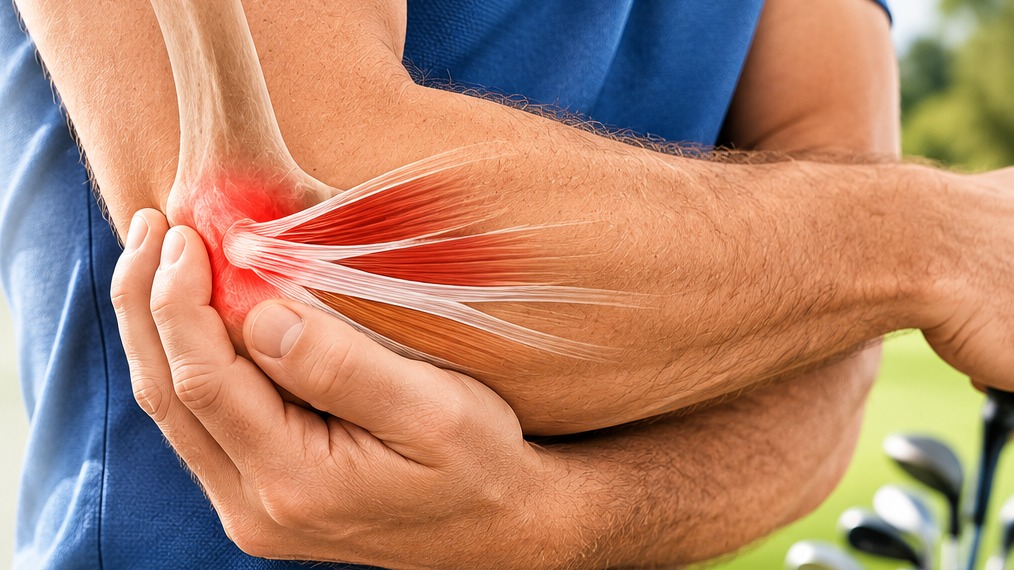
Golfer's Elbow (Medial Epicondylitis): A Complete Guide to Pain on the Inside of the Elbow
Pain on the inside of the elbow is often called golfer's elbow, although most people who develop the condition have never picked up a golf club. It is a common problem caused by irritation of the tendons that attach the muscles of the forearm to the inner part of the elbow.
Repetitive gripping, lifting, twisting and wrist movements gradually overload the tendon, leading to pain during everyday activities such as opening jars, carrying shopping, shaking hands or using tools.
The good news is that most people recover without surgery. Modern treatment focuses on understanding the condition, modifying aggravating activities and gradually rebuilding tendon strength through a structured exercise programme. Recovery takes time, but with patience and the right rehabilitation, the outlook is usually excellent.
Key points
- Golfer's elbow is a tendinopathy of the common flexor tendon, causing pain on the inside of the elbow.
- It is usually caused by repetitive gripping, lifting, wrist flexion and forearm rotation, rather than a single injury.
- Most people improve with activity modification and progressive strengthening exercises, although recovery often takes several weeks or months.
- Steroid injections may reduce pain in the short term but are not considered the best long-term treatment.
- Most patients make a full recovery without an operation if they remain consistent with rehabilitation.
Understanding the elbow
The elbow is a remarkably complex joint that allows you to bend, straighten and rotate your forearm. Several important muscles that move your wrist and fingers begin at the elbow.
On the inside of the elbow is a bony prominence called the medial epicondyle. Attached to this point is the common flexor tendon, which joins together several muscles responsible for bending the wrist, gripping objects, making a fist, turning the palm downwards and stabilising the wrist during lifting.
Every time you grip a screwdriver, lift a suitcase, swing a golf club or carry heavy shopping, these muscles pull through the common flexor tendon. Normally the tendon copes easily with these forces. Problems develop when the tendon is repeatedly overloaded without enough time to recover.
What is golfer's elbow?
Golfer's elbow, also known as medial epicondylitis, is a painful condition affecting the tendon attached to the medial epicondyle.
Although the name suggests inflammation, research over the past two decades has shown that this is usually not simply an inflammatory condition. Instead, the tendon develops tiny areas of degeneration caused by repeated overload. For this reason, many clinicians now prefer the term medial elbow tendinopathy.
This explains why treatments aimed purely at reducing inflammation often provide only temporary relief, while progressive strengthening gives better long-term results.
Why does the tendon become painful?
Think of the tendon like a strong climbing rope. A healthy rope can cope with repeated tension every day. However, if the load suddenly increases — perhaps after decorating the house, increasing gym training or starting a new manual job — small areas within the tendon become damaged.
Initially the body tries to repair these microscopic injuries. If the overload continues faster than healing can occur, the tendon becomes weaker and more sensitive to further loading. The result is pain during activities that were previously easy.
Unlike a complete tendon tear, golfer's elbow usually develops gradually over weeks or months rather than after one dramatic injury.
What causes golfer's elbow?
Repetitive use of the forearm muscles is the most common cause. Activities involving gripping, twisting and bending the wrist repeatedly place strain on the common flexor tendon.
Repetitive manual work
Many occupations place repeated stress through the common flexor tendon — plumbers, electricians, mechanics, carpenters, painters and decorators, gardeners, chefs and warehouse workers. Using hand tools for prolonged periods is a particularly common trigger.
Sports
Despite its name, relatively few patients actually develop the condition from golf. Sports commonly associated with golfer's elbow include golf, climbing, tennis, throwing sports, rowing and weightlifting. Poor technique or a sudden increase in training often contributes.
Gym training
Heavy pulling exercises such as pull-ups, rows, deadlifts and heavy curls may overload the tendon if training volume increases too quickly.
Everyday activities
Even simple tasks may become painful, including carrying shopping bags, opening jars, wringing out cloths, using secateurs, lifting kettles and typing for prolonged periods.
Who gets golfer's elbow?
Anyone can develop golfer's elbow. However, it is most commonly seen in adults between 40 and 60 years of age, with men and women affected equally.
Risk factors include repetitive manual work, repetitive sport, forceful gripping, poor lifting technique, a sudden increase in activity and inadequate recovery between training sessions.
What are the symptoms?
Symptoms usually develop gradually. The most common complaint is pain over the inside of the elbow. This pain may remain localised, spread into the forearm, become worse during gripping, increase after activity, and settle with rest during the early stages.
Common symptoms include pain and tenderness on the inside of the elbow, pain radiating into the forearm, weakness during gripping, difficulty lifting or twisting objects, and tenderness directly over the medial epicondyle.
Activities that commonly become painful
Patients frequently notice discomfort when shaking hands, opening jars, carrying shopping, pouring a kettle, lifting children, using a screwdriver, gripping golf clubs, lifting weights or turning a door handle. As symptoms progress, even holding a cup of tea may become uncomfortable.
Does the pain spread?
Yes. Although the pain starts at the medial epicondyle, it commonly radiates into the muscles on the front of the forearm. This occurs because the injured tendon is directly connected to these muscles. Some patients also describe aching after activity rather than pain during activity.
Is it always caused by golf?
No. In fact, most patients with golfer's elbow have never played golf. The condition is named because the golf swing places considerable stress on the wrist flexor muscles. However, repetitive manual work accounts for a much larger proportion of cases than golf itself.
How is golfer's elbow diagnosed?
In most cases, diagnosis is made from your symptoms, your medical history and a physical examination. Scans are not routinely required.
During the examination, your clinician will look for tenderness over the medial epicondyle, pain during resisted wrist flexion, pain when gripping, discomfort with forearm pronation and reduced grip strength. Diagnosis is usually made by examining the painful area and reproducing symptoms with resisted wrist movements.
Do I need an MRI scan?
Usually not. Most people do not require X-rays, ultrasound or MRI scans because the diagnosis is made clinically.
Imaging may occasionally be considered if symptoms persist despite treatment, another diagnosis is suspected, or surgery is being considered. Importantly, tendon abnormalities on scans do not always correlate with pain, so treatment should always focus on your symptoms and function rather than the appearance of the scan.
Treatment of golfer's elbow
The reassuring news is that the vast majority of people recover without surgery. Although golfer's elbow can be frustrating and sometimes slow to improve, modern research shows that the best results come from understanding the condition, gradually rebuilding tendon strength and avoiding treatments that simply mask the pain without addressing the underlying problem.
Exercise is the cornerstone of treatment, with rehabilitation progressing from isometric exercises in the early painful stages to eccentric and progressive strengthening exercises as symptoms improve.
The aim of treatment is to reduce pain, improve tendon health, restore grip strength, allow a return to work and sport, and prevent the problem from coming back.
Understanding tendon loading
One of the most important concepts in modern tendon rehabilitation is understanding the relationship between load and capacity.
Think of the common flexor tendon like the tow rope on a car. A healthy rope can tolerate repeated pulling without difficulty. However, if you suddenly ask it to pull much heavier loads every day, tiny areas of wear begin to develop. Your tendon behaves in exactly the same way.
Every time you grip, lift, twist, carry, swing a golf club or use tools, the tendon experiences force. If the amount of force repeatedly exceeds what the tendon can comfortably tolerate, pain develops. The solution is not complete rest forever — rehabilitation aims to gradually increase the tendon's ability to tolerate load again.
Activity modification
One of the first steps in treatment is reducing activities that repeatedly aggravate the tendon. This does not mean avoiding all use of your arm. Instead, it means temporarily reducing the activities that provoke symptoms while maintaining as much normal movement as possible.
Helpful strategies include reducing heavy lifting for a short period, taking regular breaks during repetitive work, avoiding prolonged gripping, splitting large DIY jobs over several days, modifying sporting technique and improving workstation ergonomics. Small changes made early often prevent symptoms becoming chronic.
Physiotherapy
Physiotherapy forms the foundation of treatment. The aim is not simply to reduce pain, but to restore the tendon's ability to cope with everyday loads. A good rehabilitation programme focuses on restoring tendon strength, improving forearm muscle endurance, improving grip strength, improving flexibility and gradually returning to work and sport.
Unlike passive treatments such as massage or ultrasound, physiotherapy actively stimulates tendon remodelling.
Stage 1 — isometric exercises
During the early painful phase, even simple gripping may be uncomfortable. This is where isometric exercises are useful. These involve contracting the muscles without moving the wrist — for example holding gentle wrist flexion against resistance, squeezing a soft ball without pain, and static forearm contractions.
Beginning with isometric loading can reduce pain while maintaining muscle activity. Pain during these exercises should remain mild and should settle reasonably quickly afterwards.
Stage 2 — eccentric strengthening
Once pain becomes more manageable, rehabilitation progresses to eccentric exercises. During eccentric loading the muscle contracts while slowly lengthening. For golfer's elbow this usually involves slowly lowering the wrist from a flexed position while holding a light weight.
Research suggests that eccentric loading encourages healthy tendon remodelling and helps improve the tendon's ability to tolerate load over time.
Stage 3 — heavy slow resistance training
As symptoms continue improving, exercises become progressively more demanding. This stage often includes heavier wrist curls, resisted forearm pronation, resisted gripping exercises, resistance bands and functional lifting exercises.
The emphasis is on slow, controlled movements rather than lifting as much weight as possible. This gradual progression allows the tendon to adapt safely.
Stretching
Stretching can help improve flexibility of the forearm muscles. Typical stretches involve straightening the elbow, gently extending the wrist and holding the stretch for around 20–30 seconds.
Stretching alone is unlikely to cure golfer's elbow, but it complements strengthening exercises as part of a comprehensive rehabilitation programme.
Can I continue exercising?
Usually yes. Remaining active is encouraged. Most people can continue walking, cycling, lower-body gym exercises and running while temporarily modifying activities that repeatedly aggravate the elbow. If you play golf or another racquet sport, it is often possible to continue at a reduced intensity while rehabilitation progresses.
Braces
Counterforce braces and elbow straps are commonly used. They work by slightly altering the forces transmitted through the common flexor tendon during gripping. Some people notice reduced pain during activity, improved confidence and better tolerance of manual work.
However, braces do not repair the tendon itself. They should therefore be viewed as a temporary aid while strengthening continues.
Ice
Ice may help reduce symptoms after activities that aggravate the tendon. Applying an ice pack wrapped in a towel for approximately 10–15 minutes after heavy activity can provide temporary pain relief. Ice does not repair the tendon but may help manage flare-ups.
Pain relief
Simple pain relief can make rehabilitation easier. Common options include paracetamol, topical anti-inflammatory gel and oral anti-inflammatory medication if appropriate. Medication should be viewed as a way of controlling symptoms while completing rehabilitation rather than replacing exercise.
Massage
Massage may reduce muscle tightness around the forearm. However, it does not reverse the underlying tendon changes. Most physiotherapists therefore use massage only as an adjunct to a progressive strengthening programme.
Corticosteroid injections
Many patients ask whether a steroid injection will solve the problem. Steroid injections can reduce pain quite quickly. However, this short-term benefit comes with important limitations.
Current evidence suggests they often provide only temporary pain relief, do not improve tendon strength, and may increase recurrence rates compared with exercise-based rehabilitation. For these reasons, steroid injections are no longer recommended as routine first-line treatment and should generally be reserved for carefully selected patients after discussing the risks and benefits.
Platelet-rich plasma (PRP)
PRP injections aim to stimulate tendon healing using concentrated platelets taken from your own blood. Although the theory is attractive, current evidence remains mixed. Some studies show modest improvements, while others demonstrate little difference compared with exercise alone.
At present the evidence remains inconsistent, treatment protocols vary, and PRP is not routinely recommended within standard NHS care. Patients considering private PRP treatment should understand that rehabilitation remains essential regardless of whether an injection is performed.
Shockwave therapy
Extracorporeal shockwave therapy (ESWT) delivers controlled sound waves into the tendon. It may be considered for patients whose symptoms have persisted despite several months of rehabilitation.
Current evidence suggests some patients improve, others experience little benefit, and multiple treatment sessions are usually required. Shockwave therapy should usually complement a strengthening programme rather than replace it.
When is surgery needed?
Fortunately, very few patients require surgery. Most recover with education, activity modification, progressive strengthening and physiotherapy.
Surgery may be considered if symptoms have persisted for 6–12 months or longer, well-supervised rehabilitation has failed, pain continues to significantly interfere with work or sport, and other causes of medial elbow pain have been excluded. The aim is always to exhaust non-operative treatments before considering an operation.
What does surgery involve?
Several operations have been described. Most involve removing unhealthy tendon tissue, stimulating a healing response, preserving healthy tendon where possible and occasionally reattaching the tendon if required.
Operations may be performed through a small open incision or using minimally invasive techniques in selected cases. Following surgery, physiotherapy remains essential to rebuild strength and gradually return to normal activities.
Recovery
The outlook for golfer's elbow is excellent. Although symptoms can sometimes be frustratingly slow to settle, the vast majority of people recover without surgery.
Unlike a muscle strain, tendons heal gradually. Improvement is usually measured in weeks to months, not days, and recovery requires patience with a structured exercise programme.
One of the most important things to understand is that recovery is rarely a straight line. Many patients notice good weeks followed by a flare-up, temporary discomfort after heavier activity, and gradual improvements in strength before pain completely settles. These small setbacks are a normal part of tendon rehabilitation and do not necessarily mean the tendon has been damaged again.
| Time | What to expect |
|---|---|
| First 2 weeks | Reduce aggravating activities, begin isometric exercises, improve understanding of the condition and manage pain. |
| 2–6 weeks | Progress to eccentric strengthening. Everyday activities such as lifting light objects often become easier. |
| 6–12 weeks | Continue progressive strengthening with increasing grip strength and improved tolerance of work and sport. |
| 3–6 months | Most patients have returned to normal daily activities with significantly reduced pain. |
| 6–12 months | Ongoing tendon remodelling continues. Most patients have returned fully to work, hobbies and recreational sport. |
Returning to work
Most people do not need prolonged time off work. Instead, temporary modifications may be helpful.
For office workers this may include improving workstation ergonomics, changing mouse position, taking regular breaks and avoiding prolonged gripping. For manual workers it may mean reducing heavy repetitive lifting, using larger-handled tools, alternating tasks and avoiding sustained forceful gripping where possible.
A gradual return to heavier work is generally preferable to stopping work completely.
Returning to golf
Although most patients do not develop golfer's elbow from golf, many golfers understandably want to know when they can return. You should usually consider returning once everyday activities are comfortable, grip strength has improved, strengthening exercises are well tolerated and you can practise swings without significant pain.
Initially, reduce the number of balls hit, avoid long practice sessions and rebuild gradually over several weeks. Having a PGA professional assess your swing may also reduce excessive stress on the tendon.
Returning to the gym
Most gym exercises can continue with sensible modification. Initially it may help to reduce or temporarily avoid heavy pull-ups, heavy rows, deadlifts, heavy biceps curls, thick-grip exercises and heavy kettlebell carries.
As symptoms improve, these exercises can usually be reintroduced progressively. The goal is to increase tendon capacity — not to avoid loading forever.
What if it doesn't improve?
Most patients improve steadily over time. However, further assessment may be appropriate if symptoms persist beyond 6–12 months, pain continues despite completing a structured rehabilitation programme, symptoms are becoming progressively worse, numbness or tingling develops, there is significant weakness, or another diagnosis is suspected. Further investigations such as ultrasound or MRI may occasionally be useful at this stage.
Treatment comparison
| Treatment | Main role | Advantages | Limitations |
|---|---|---|---|
| Education | Understanding the condition | Improves confidence and supports rehabilitation | Requires patient engagement |
| Activity modification | Reduce tendon overload | Often improves symptoms early | Temporary changes to work or sport may be needed |
| Physiotherapy | Restore tendon capacity | Strongest evidence for long-term improvement | Requires commitment over several months |
| Isometric exercises | Early pain management | Useful during painful flare-ups | Should progress to strengthening |
| Eccentric and heavy slow resistance exercises | Improve tendon strength | Addresses the underlying problem | Benefits develop gradually |
| Counterforce brace | Reduce load during gripping | May ease pain during work or sport | Does not repair the tendon |
| Pain relief | Control symptoms | Helps you keep rehabilitating | Does not treat the tendon problem |
| Corticosteroid injection | Short-term pain relief | May reduce pain quickly | Higher recurrence than exercise; no long-term benefit |
| Shockwave therapy | Persistent symptoms | May help selected patients | Results vary; several sessions needed |
| Surgery | Persistent symptoms after 6–12 months | Can help when rehabilitation has failed | Rarely needed; recovery still requires physiotherapy |
Frequently asked questions
Is golfer's elbow actually inflammation?
Not usually. Although the name medial epicondylitis suggests inflammation, current evidence indicates that golfer's elbow is primarily a tendinopathy involving degeneration and reduced tendon capacity rather than ongoing inflammation. This explains why progressive strengthening is much more important than simply trying to reduce inflammation.
Should I rest my arm completely?
No. Complete rest usually results in further weakness. Instead, temporarily reduce activities that significantly aggravate symptoms, continue using the arm normally where possible, and complete your strengthening exercises consistently. Rehabilitation programmes emphasise gradual loading rather than prolonged immobilisation.
Is some pain during exercise normal?
Yes. A small amount of discomfort during rehabilitation is generally acceptable. A useful guide is that pain should remain mild to moderate, symptoms should settle within a reasonable time afterwards, and pain should not become progressively worse over several days. Your physiotherapist may advise using a simple pain-monitoring scale to help guide exercise progression.
Can it come back?
Yes. Like any tendon problem, golfer's elbow can recur if the tendon is suddenly overloaded again. Common triggers include large DIY projects, sudden increases in gym training, excessive golf practice and repetitive manual work. Maintaining forearm strength and increasing activity gradually can significantly reduce the risk of recurrence.
Will I need surgery?
Probably not. The overwhelming majority of patients recover without an operation. Surgery is generally reserved for the small number of patients with persistent symptoms after prolonged, well-supervised non-operative treatment.
Are steroid injections a quick fix?
They may reduce pain in the short term, but they do not repair the tendon. Current evidence suggests that while corticosteroid injections can provide temporary symptom relief, they are not associated with better long-term outcomes than exercise-based rehabilitation and should not be considered a cure.
The OrthoZone take-home message
Golfer's elbow is a common tendon problem affecting the inside of the elbow, usually caused by repetitive gripping, lifting and wrist movements rather than golf. It is a tendinopathy rather than a simple inflammatory condition, which is why progressive strengthening — not injections — produces the best long-term results. Modify the activities that overload the tendon, load it gradually through a structured exercise programme, and be patient: recovery is measured in months, but the great majority of people return fully to work, hobbies and sport without surgery.
Top tips
- Don't wait for the pain to disappear before starting exercises — gradual loading is what restores tendon capacity.
- Modify, don't stop. Reducing heavy gripping temporarily is far better than avoiding all movement.
- Use bigger handles and take regular breaks at work — small ergonomic changes remove a surprising amount of tendon load.
- Expect recovery to take time. Tendons heal more slowly than muscles, so improvements are usually gradual over several months.
- Be consistent. Completing your exercise programme regularly is far more important than searching for a quick fix.
Related articles
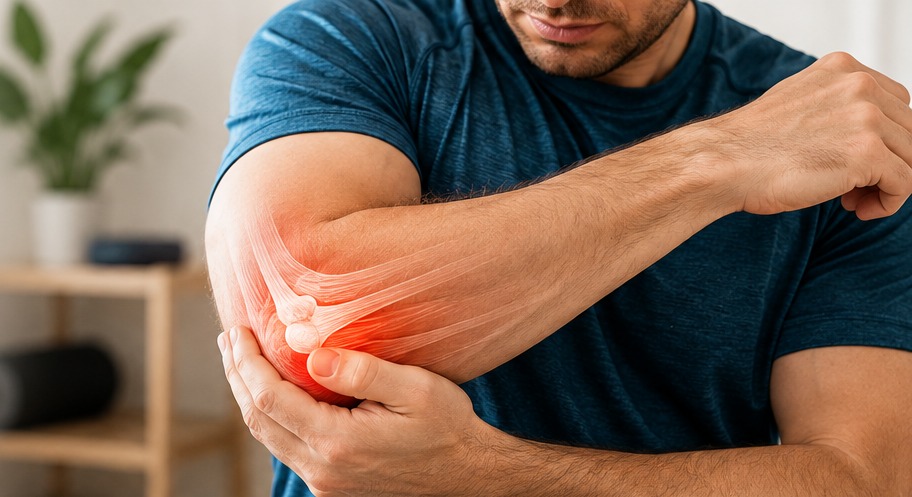
Tennis Elbow (Lateral Elbow Tendinopathy): Symptoms, Causes and Treatment
Evidence-based advice on tennis elbow: what causes it, how it is diagnosed, which treatments genuinely help and why most people recover without surgery.
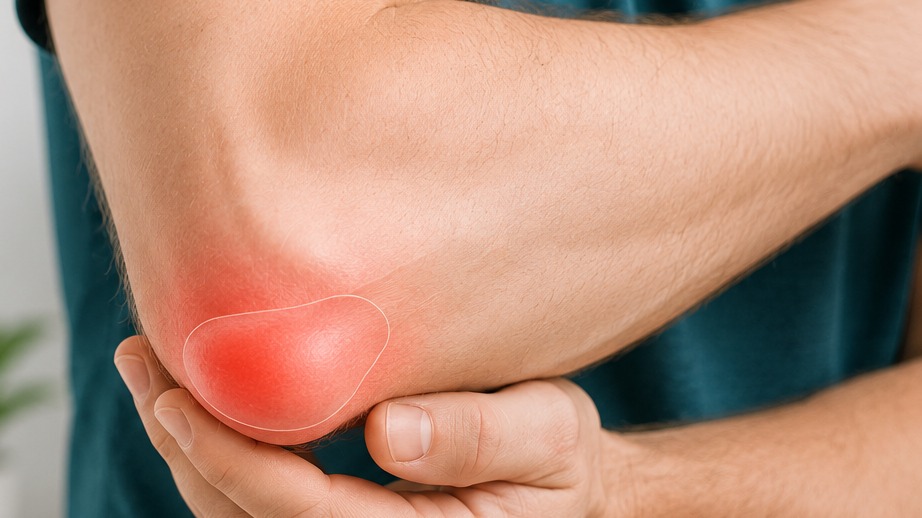
Olecranon Bursitis (Student's Elbow): A Complete Guide to Swelling Behind the Elbow
A complete guide to olecranon bursitis (student's elbow), including symptoms, causes, infection, aspiration, surgery and evidence-based treatment.