
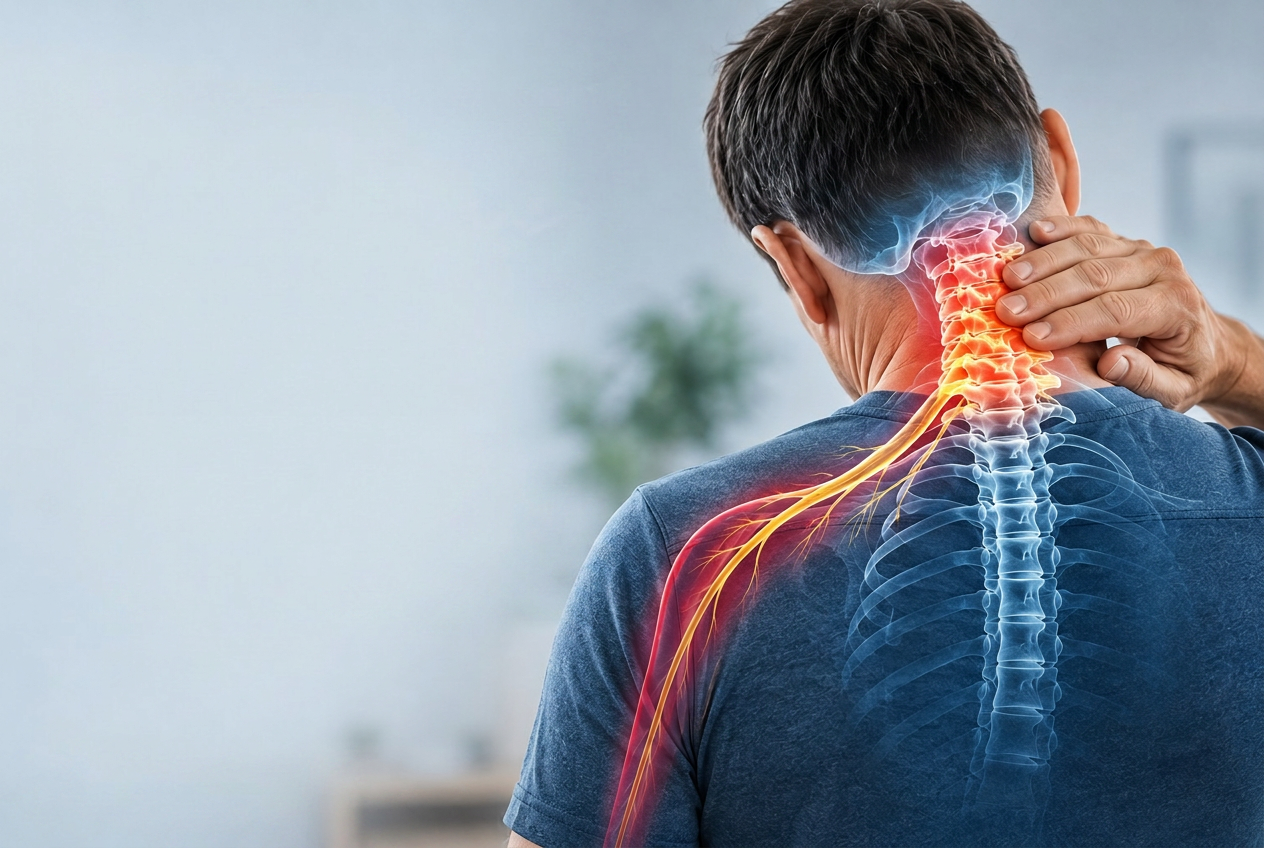
Neck Pain and Cervical Radiculopathy (Trapped Nerve): A Complete Guide
Neck pain is one of the commonest musculoskeletal problems, affecting around two out of every three people at some point during their lives. Fortunately, in most cases it is not caused by a serious injury or disease, and the pain usually improves within a few weeks with simple self-management, remaining active and gradual exercise. NHS guidance consistently emphasises that most people experience significant improvement within six to eight weeks, even though symptoms may initially be uncomfortable.
Sometimes, however, neck pain is accompanied by pain, tingling or numbness travelling into the shoulder or arm. This is called cervical radiculopathy, often referred to as a trapped nerve in the neck. Although the symptoms can be alarming, many people recover without surgery.
This guide explains what causes neck pain, what cervical radiculopathy actually means, why symptoms travel into the arm, when you need a scan, which treatments are supported by evidence, when surgery may be appropriate and what you can do to speed your recovery.
Key points
- Neck pain affects around two-thirds of people during their lifetime and is usually not caused by serious disease.
- Most episodes improve naturally within 2–8 weeks, although recovery varies between individuals.
- Pain travelling into the arm may indicate cervical radiculopathy, where a nerve root becomes irritated or compressed.
- Most people do not require X-rays or MRI scans in the early stages, because imaging rarely changes initial treatment.
- Progressive weakness, difficulty walking, problems with bladder or bowel control or severe loss of sensation require urgent medical assessment.
Understanding the neck
The neck, also known as the cervical spine, supports the weight of your head while allowing an extraordinary range of movement. Every day it allows you to look up and down, turn your head, drive, read, work at a computer, exercise and sleep comfortably.
To achieve this combination of movement and stability, the cervical spine contains seven cervical vertebrae (C1–C7), intervertebral discs, facet joints, strong ligaments, muscles and tendons, the spinal cord and eight cervical nerve roots. Each of these structures can contribute to neck pain — and fortunately, they are also remarkably resilient.
What is neck pain?
Neck pain simply means pain arising from the structures within the cervical spine. It may involve muscles, joints, ligaments, discs or nerves. Most episodes are described as mechanical neck pain, which means the pain relates to how the tissues are functioning rather than to a serious disease.
Many people assume something must have “gone out of place”. Fortunately, this is almost never the case. Instead, the pain usually reflects temporary irritation of muscles, joints or ligaments that gradually settles as the tissues recover. NHS guidance explains that the exact reason for neck pain is often unclear, and that this is entirely normal.
What is cervical radiculopathy?
Cervical radiculopathy is different from ordinary neck pain. Instead of pain remaining within the neck itself, one of the nerve roots leaving the cervical spine becomes irritated or compressed, causing symptoms that travel along the course of that nerve.
Depending on which nerve is affected, symptoms may include shoulder pain, pain down the arm, tingling, pins and needles, numbness, or weakness in the arm or hand. Many people describe this as a trapped nerve. Although that description is useful, irritation of the nerve is usually caused by a combination of inflammation, disc bulging and age-related narrowing around the nerve, rather than the nerve simply being “trapped”.
Neck pain vs cervical radiculopathy
| Mechanical neck pain | Cervical radiculopathy |
|---|---|
| Pain mainly in the neck | Pain travels into the shoulder or arm |
| Muscle stiffness | Tingling or numbness common |
| Headaches may occur | Weakness may occur |
| Usually no neurological symptoms | Symptoms follow a nerve distribution |
| Local muscle tenderness | Nerve irritation is the main problem |
What causes neck pain?
Most neck pain develops because the tissues have been asked to do more than they can comfortably tolerate.
Muscle strain
Probably the commonest cause. Decorating ceilings, carrying heavy bags, gardening, prolonged computer work or an awkward sleeping position can all overload the muscles and make them painful.
Prolonged sitting
Many people spend several hours each day working on computers, using laptops, looking at phones or driving. Remaining in one position for prolonged periods places sustained load through the muscles and joints of the neck. NHS guidance recommends changing position every 20–30 minutes rather than maintaining one posture.
Trauma
Whiplash injuries, sporting injuries, falls and road traffic collisions can stretch the muscles, ligaments and joints within the neck.
Stress
One of the most overlooked causes. Stress often causes unconscious tightening of the neck and shoulder muscles, and psychological stress, anxiety and depression can reduce pain tolerance.
Lifestyle factors
Poor sleep, smoking, lack of exercise, obesity and prolonged inactivity all influence recovery and the likelihood of persistent symptoms. Improving these factors often improves recovery as well.
What causes cervical radiculopathy?
Cervical disc prolapse
Between each vertebra lies an intervertebral disc, made up of a tough outer ring and a softer gel-like centre. Sometimes the disc bulges backwards, and if this bulge presses against a nearby nerve root, pain may travel into the arm. This is often described as a slipped disc, although the disc does not actually slip out of place.
Age-related narrowing
As we get older, discs gradually lose height, joints enlarge slightly and ligaments thicken. Together these changes can narrow the opening through which the nerve leaves the spine — known as foraminal stenosis. Unlike a disc prolapse, this usually develops gradually over time.
Risk factors
Certain factors increase the risk of neck pain: prolonged desk work, frequent mobile phone use, repetitive overhead work, poor general fitness, smoking, previous neck pain, physically demanding occupations, psychological stress and poor sleep quality. Many of these are modifiable, meaning that changing lifestyle habits can reduce future episodes.
What does neck pain feel like?
Symptoms vary considerably. Many people describe aching, stiffness, muscle tightness, difficulty turning the head, pain when looking over the shoulder, headaches and discomfort between the shoulder blades. Clicking or grating sensations, headaches or light-headedness are also common and are often not caused by serious disease.
Symptoms of cervical radiculopathy
When a nerve root becomes irritated, symptoms often extend beyond the neck: pain radiating into the shoulder or arm, burning pain, electric shock-like pain, pins and needles, numbness, weakness and reduced grip strength. Unlike mechanical neck pain, these symptoms usually follow the pathway of a particular nerve.
Which nerve is affected?
| Nerve root | Typical symptoms |
|---|---|
| C5 | Shoulder pain and weakness lifting the arm |
| C6 | Pain into the thumb with altered sensation over the thumb and index finger |
| C7 | Pain into the middle finger with weakness extending the elbow or wrist |
| C8 | Pain into the ring and little fingers with reduced grip strength |
How is it diagnosed?
For most people the diagnosis can be made from your symptoms, your medical history and a physical examination. Scans are not usually required in the early stages because they rarely alter the initial treatment plan.
Your clinician will ask where exactly the pain is, whether it travels into your arm, whether you have tingling, numbness or weakness, whether symptoms started suddenly or gradually, whether you have had previous episodes, and whether there are any problems with walking, balance, bladder or bowel function.
During the examination they may assess posture, neck movement, muscle tenderness, shoulder movement, arm strength, sensation, reflexes and grip strength, and perform gentle tests that reproduce arm pain by narrowing the space around the cervical nerve roots.
Do I need an X-ray?
Usually no. X-rays mainly show bones, fractures, severe arthritis and spinal alignment. They do not show discs, nerves, muscles, ligaments or the spinal cord. Age-related changes are also extremely common — many healthy adults with no neck pain at all have arthritis visible on X-ray. For these reasons, routine X-rays are not recommended for uncomplicated neck pain.
Do I need an MRI scan?
MRI scans provide far more detail, showing discs, nerve roots, the spinal cord, ligaments, muscles and inflammation. However, most people still do not need an MRI immediately. In the first few weeks, MRI findings rarely change treatment: whether the scan shows a small disc bulge, age-related wear or mild narrowing, the recommended treatment is usually exactly the same — remain active, manage the pain, begin rehabilitation and allow time for recovery.
When is an MRI helpful?
An MRI may become appropriate if symptoms persist despite appropriate treatment, surgery is being considered, progressive weakness develops, there are significant neurological symptoms, cervical myelopathy is suspected or another diagnosis is possible.
MRI findings should always be interpreted alongside your symptoms. Many people have disc bulges, arthritis and narrowed nerve exits without experiencing any pain whatsoever. Treating the MRI instead of the patient can lead to unnecessary interventions.
Red flag symptoms
Although most neck pain is not serious, a small number of symptoms require urgent medical assessment because they may indicate spinal cord compression, infection, fracture or malignancy.
| Red flag symptom | Why it matters |
|---|---|
| Rapidly worsening arm weakness, or weakness in both arms | Possible progressive nerve or spinal cord compression |
| Difficulty walking, poor balance or loss of hand coordination | Possible cervical myelopathy — urgent assessment |
| Bladder or bowel problems, or numbness around the saddle area | Possible significant cord compression — emergency |
| Severe neck pain following major trauma | Possible fracture or instability |
| Fever with neck pain | Possible spinal infection |
| Unexplained weight loss, or severe night pain not relieved by rest | Requires assessment for tumour |
What is cervical myelopathy?
Unlike cervical radiculopathy, which affects a single nerve root, cervical myelopathy occurs when the spinal cord itself becomes compressed. This is much less common but considerably more serious.
Symptoms may include clumsy hands, difficulty fastening buttons, dropping objects, worsening handwriting, poor balance, walking difficulties, stiffness in both legs and bladder problems. Because the spinal cord carries signals to the entire body below the neck, compression can affect both the arms and the legs. Patients with suspected cervical myelopathy should be referred urgently for specialist assessment.
Treatment principles
The good news is that the majority of people recover without surgery. Treatment focuses on reducing pain, maintaining movement, restoring confidence, strengthening the supporting muscles and gradually returning to normal activities. For cervical radiculopathy the aim is also to allow the irritated nerve time to settle. Many disc prolapses gradually shrink naturally as inflammation resolves and the body absorbs some of the protruding disc material.
Stay active
Perhaps the single most important message is: keep moving. Years ago, prolonged rest and cervical collars were commonly prescribed. Modern evidence shows that prolonged inactivity can increase stiffness, weaken muscles, delay recovery and increase fear of movement. Maintain your normal daily activities wherever possible while avoiding movements that cause a major flare-up. Walking remains one of the best early forms of exercise.
Pain relief
Pain medication may help you remain active during recovery. Depending on your individual circumstances, options may include paracetamol, topical anti-inflammatory gels and oral anti-inflammatory medication (NSAIDs) if appropriate. Medication should support rehabilitation rather than replace it.
Heat or ice?
Both can be useful. Heat — warm showers, heat packs or wheat bags — is often particularly helpful for muscle tightness, stiffness and aching pain. Ice may be more comfortable immediately after a minor injury or after activities that temporarily increase symptoms. Apply either for around 15–20 minutes, protecting the skin with a towel. Neither speeds healing significantly, but both may make movement easier.
Sleep
Neck pain often feels worse after a poor night's sleep. Use a supportive pillow that keeps the neck in a neutral position, avoid sleeping on several stacked pillows, sleep on your back or side if comfortable, and change position during the night if stiffness develops. The ideal pillow supports the natural curve of the neck without pushing the head too far forwards or sideways.
Workstation advice
Position the top of the monitor at eye level, keep the screen directly in front of you, support the forearms when typing, avoid prolonged “chin-down” phone use, stand up every 20–30 minutes and stretch regularly throughout the day. Rather than searching for the “perfect posture”, it is usually more important to change position frequently.
Physiotherapy
Physiotherapy is one of the most effective treatments for both mechanical neck pain and cervical radiculopathy. Rather than simply trying to reduce pain, it aims to restore normal movement, improve muscle strength and endurance, reduce stiffness, improve movement patterns and restore confidence in using the neck. Rather than attempting to “put the neck back into place”, physiotherapy improves the neck's ability to tolerate everyday activities.
Exercises
Exercise is one of the few treatments consistently shown to improve neck pain over the medium and long term. A rehabilitation programme usually progresses through several stages.
| Stage | Focus | Typical exercises |
|---|---|---|
| 1. Restore movement | Reduce stiffness without significantly increasing pain | Gentle neck rotations, looking up and down, side bending, shoulder rolls, chin tucks |
| 2. Stretching | Improve flexibility and reduce strain on the cervical spine | Upper trapezius, levator scapulae, pectoral and scalene stretches |
| 3. Strengthening | Improve endurance of the supporting muscles | Deep neck flexor exercises, scapular strengthening, shoulder blade retraction, resisted neck movements |
| 4. Functional rehabilitation | Restore confidence and everyday tolerance | Lifting, carrying, overhead work, sport and hobbies |
Nerve gliding exercises
For cervical radiculopathy, physiotherapists sometimes prescribe nerve mobility exercises, often called nerve glides or neural mobilisation. These aim to improve movement of the irritated nerve, reduce sensitivity and restore normal mobility. They should always be introduced gradually, and symptoms should settle reasonably quickly after completing them.
How long does recovery take?
Most people with mechanical neck pain improve within 2–8 weeks, and many recover much sooner, although some stiffness may continue a little longer after prolonged sitting.
Recovery from cervical radiculopathy is often slightly slower. Many people improve over 6–12 weeks, and some continue to improve gradually over 3–6 months as the irritated nerve recovers. Nerves heal much more slowly than muscles, so even after the pain has settled numbness may continue improving for several months.
| Time | Expected progress |
|---|---|
| First 1–2 weeks | Pain may be uncomfortable but gentle movement should continue. |
| 2–6 weeks | Neck movement improves and stiffness reduces. |
| 6–12 weeks | Most people return to normal daily activities with much less pain. |
| 3–6 months | Continued improvement in nerve symptoms, strength and endurance if cervical radiculopathy was present. |
Work, driving and the gym
For most people, remaining at work — or returning as soon as reasonably possible — is beneficial. Temporary adjustments may include shorter working days, more frequent breaks, changing computer height, avoiding prolonged static positions and reducing repetitive overhead work.
Driving is usually safe once you can comfortably turn your head, check blind spots, perform an emergency stop safely and control the vehicle without severe pain. On longer journeys, stop regularly, stretch and walk for a few minutes.
Exercise is encouraged. Initially you may wish to reduce very heavy overhead presses, heavy shrugs, heavy deadlifts, contact sports and explosive lifting, focusing instead on cardiovascular fitness and controlled, progressive strengthening before building back up.
When is surgery needed?
The reassuring news is that the vast majority of people with neck pain or cervical radiculopathy never require surgery. Most improve through time, remaining active, physiotherapy, progressive exercise and appropriate pain management.
Surgery is usually only considered when symptoms have persisted despite appropriate non-operative treatment, MRI findings clearly match the symptoms and examination, there is progressive muscle weakness, there is significant spinal cord compression (cervical myelopathy), or pain remains severe enough to significantly affect quality of life. The decision to operate is never based on the MRI scan alone.
Anterior cervical discectomy and fusion (ACDF)
The commonest operation for cervical radiculopathy. Through a small incision at the front of the neck, the surgeon moves aside the muscles, windpipe and food pipe, removes the damaged disc, relieves pressure on the nerve root and spinal cord, inserts a cage or bone graft into the disc space and usually stabilises the segment with a small plate and screws. Patients are often surprised the operation is performed through the front of the neck, but this approach gives excellent access while minimising disruption to the muscles at the back.
Cervical disc replacement
For selected patients, the damaged disc can be replaced with an artificial disc designed to preserve movement rather than fusing two vertebrae together. Potential advantages include maintaining motion at the operated level, potentially reducing stress on adjacent levels and quicker return of neck movement. It is generally considered in younger patients with single-level disc disease, minimal arthritis and good spinal alignment.
Posterior cervical foraminotomy
Rather than removing the entire disc, the surgeon approaches from the back of the neck and enlarges the opening through which the nerve exits. This may be appropriate when nerve compression is mainly within the foramen, neck pain is minimal and arm pain is the dominant symptom. Spinal motion is usually preserved because fusion is not required.
Recovery after surgery
| Time | Recovery |
|---|---|
| First few days | Walking encouraged, light daily activities, pain gradually improving |
| 2–6 weeks | Increasing activity, gentle neck exercises, return to light office work for many patients |
| 6–12 weeks | Most patients return to driving, everyday activities and progressive strengthening |
| 3–6 months | Continued improvement in strength, endurance and nerve recovery |
| Up to 12 months | Ongoing improvement in numbness and muscle strength if nerve compression was significant |
Frequently asked questions
Can I exercise?
Yes. Exercise is one of the most effective treatments for neck pain. Begin gently and increase activity gradually.
Should I wear a soft collar?
Usually no. Soft collars were commonly prescribed in the past, but prolonged collar use may weaken the supporting muscles and delay recovery. If a collar is used following a specific injury, it should be under the guidance of a healthcare professional.
Can I sleep on my side?
Yes. Many people find side sleeping comfortable provided the pillow supports the head in a neutral position, so the neck does not bend excessively to either side.
Why does my neck click?
Clicking or cracking sounds are extremely common and are usually caused by tendons moving, small pressure changes within the joints or normal joint movement. Clicking alone is not usually a sign of arthritis or damage.
Will a disc bulge heal?
Often, yes. Many cervical disc prolapses reduce in size naturally over time as inflammation settles and the body gradually absorbs some of the protruding disc material. This is one reason why many patients improve without surgery.
Can stress cause neck pain?
Stress does not directly damage the neck, but it can increase muscle tension, reduce pain tolerance and make symptoms feel more intense. Managing stress is therefore an important part of treatment for some patients.
Treatment comparison
| Treatment | Role | Advantages | Limitations |
|---|---|---|---|
| Education and reassurance | Understanding the condition | Reduces anxiety and encourages recovery | Requires patient engagement |
| Staying active | Maintain movement | Strong evidence for improving recovery | Symptoms may temporarily fluctuate |
| Physiotherapy | Restore movement and strength | Excellent long-term outcomes | Requires consistency |
| Exercise programme | Improve flexibility and endurance | Strong evidence | Benefits develop gradually |
| Heat therapy | Reduce muscle stiffness | Helpful for symptom relief | Temporary benefit |
| Pain relief | Improve comfort | Supports rehabilitation | Does not treat the underlying cause |
| MRI scan | Selected patients only | Identifies nerve compression and spinal cord problems | Not routinely required early on |
| ACDF | Persistent nerve compression | Excellent relief of arm pain in selected patients | Requires surgery and recovery |
| Cervical disc replacement | Motion-preserving surgery | Maintains movement at the operated level | Suitable only for selected patients |
| Posterior cervical foraminotomy | Relieve foraminal nerve compression | Preserves spinal motion | Not appropriate for every pattern of compression |
The OrthoZone take-home message
Neck pain is extremely common and, although it can be very painful, it is rarely caused by serious disease. Most people recover with reassurance, remaining active and progressive exercise. Cervical radiculopathy can cause pain, numbness or weakness travelling into the arm, but even this often improves without surgery. Imaging and operations are reserved for carefully selected patients, particularly those with persistent nerve compression or spinal cord involvement. Understanding your condition, staying active and following a structured rehabilitation programme provide the best chance of a full recovery.
Top tips
- Keep moving. Gentle movement usually helps recovery more than prolonged rest.
- Don't panic if pain travels into your arm. Cervical radiculopathy often improves without surgery.
- Improve your workstation, but don't obsess over posture — changing position regularly matters more.
- Build strength gradually. Progressive exercise is one of the best ways to improve long-term neck health.
- Know the warning signs. Progressive weakness, balance problems, clumsy hands or bladder and bowel symptoms need urgent assessment.
Related articles
Lower Back Pain: Causes, Symptoms, Treatment and Recovery
An evidence-based guide to lower back pain: what causes it, the red flags that need urgent assessment, which treatments work and how long recovery takes.
Sciatica: A Complete Guide to Leg Pain Caused by a Trapped Nerve
A complete guide to sciatica: what causes leg pain from a trapped nerve, whether you need an MRI scan, which treatments work and when surgery helps.